
A 20-litre, 800W solo microwave is the sweet spot for most small UK kitchens, delivering a full reheat in under four minutes while sitting comfortably on a standard 600mm worktop shelf. This guide compares four shortlisted models across the budget bracket, from simple manual-dial units to digital models with more power levels, so you can pick the right one without overspending on features you will not use.
What to look for
01Wattage and cooking speed
On the UK 240V mains supply, microwave wattage directly determines how quickly food heats through. An 800W model will reheat a bowl of soup in roughly 2 minutes; a 700W unit takes closer to 2.5 minutes for the same job. That gap sounds small, but across daily use it adds up. Most compact models in this price bracket sit at either 700W or 800W, so check the spec sheet rather than assuming. Higher wattage also gives you more headroom when defrosting denser items such as a 500g chicken breast. If you cook from frozen regularly, prioritise 800W. For occasional reheating only, 700W is perfectly adequate and can shave a few pounds off the purchase price.
02Capacity and worktop footprint
Twenty litres is the standard capacity for compact solo microwaves and comfortably fits a standard dinner plate (up to about 27cm diameter) or a 23cm (9-inch) pizza. The external footprint matters just as much as the internal volume. Most 20-litre units measure roughly 45cm wide by 35cm deep, which fits neatly under a standard UK wall cabinet with clearance to spare. If your kitchen has a particularly tight alcove or a low shelf, measure the depth from wall to worktop edge before ordering. Turntable diameter is worth checking too: a 25.5cm glass plate is typical, but some budget models drop to 24.5cm, which can make fitting a large mug awkward.
03Power levels and defrost settings
More power levels give you finer control. Five levels is the minimum you should accept: it covers defrost (around 30%), simmer (50%), reheat (70-80%), and full power (100%). Eleven levels, as found on some digital models, lets you dial in gentler settings for melting chocolate or softening butter without hot spots. Automatic defrost, where you enter the food weight and the microwave calculates time and power, is genuinely useful for busy households. Manual defrost works fine but requires more attention. If you live in a hard-water area such as London or the South East, also check whether the interior is described as easy-clean or has a smooth enamel lining, as limescale splatter is harder to remove from textured surfaces.
04Controls: digital versus manual dial
Digital touch-pad controls look sleeker and are easier to wipe down, but they can feel fiddly if you just want to add 30 seconds quickly. Manual dial models are faster to operate one-handed, which matters when you are holding a hot dish. Preset auto-cook menus (typically covering items like jacket potatoes, soup, and beverages) are a convenience feature rather than a necessity, but they do reduce guesswork for common tasks. A clock and kitchen timer function is worth having if your kitchen does not already have one built into the oven. Most models in this guide include both, so it is not a differentiator at this price point, but confirm it is present if you are considering a very budget-focused option.
Our top picks
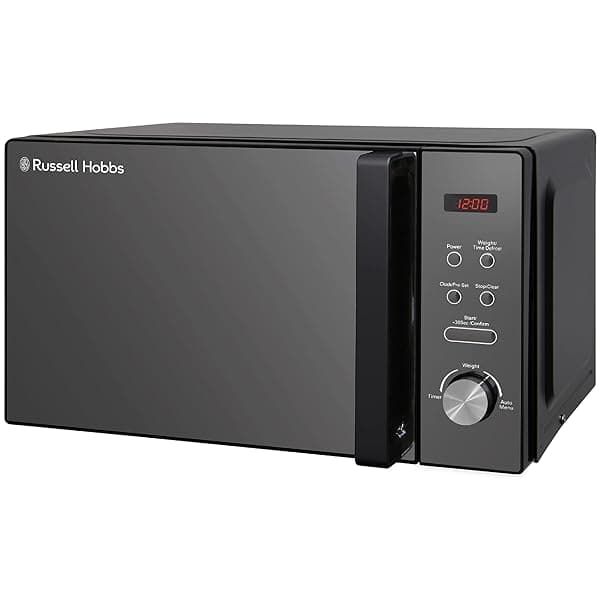
Best all-rounder for daily useRussell Hobbs RHM2076B 20 Litre 800
800W output and 20-litre capacity cover full meals and quick reheats alike, with 5 power levels and automatic defrost so you enter the weight rather than guessing timings. Eight auto-cook menus handle common jobs like jacket potatoes and reheating drinks without you setting power and time manually. The interior is finished for easy cleaning, useful if you live in a hard-water area where splatter and limescale build up faster. A solid, no-compromise choice for a household that uses the microwave daily.
Best budget pickTOSHIBA 20 Liter 800W Manual Control
Manual dial controls strip out the digital touchpad, which keeps the price down and makes the microwave faster to operate one-handed when you are holding a hot dish. It still delivers 800W and 20 litres of capacity, with 5 power levels and automatic defrost, matching the core specification of pricier digital models. The 20-litre drum comfortably fits a 9-inch pizza. For a student flat, a first home, or a secondary kitchen, this covers the essentials without paying for a touch display.
Best for finer power controlTOSHIBA 20 Liter 800W Digital Solo
Eleven power levels give you noticeably more control than the standard five, useful for gentler jobs like melting chocolate or softening butter without hot spots. One-touch express cook with six preset recipes and a digital display round out the feature set, alongside 800W output and 20-litre capacity shared with the rest of this guide. If you cook a wider range of dishes in the microwave rather than just reheating, the extra power levels are the main reason to pick this over the manual-dial model.
Best compact footprintHisense 700 Watts 20 Litre Inverter

At 24.1cm tall, 43.4cm wide and 32.9cm deep, this is a genuinely compact 20-litre unit, worth measuring against your cupboard clearance if space is tight. Inverter technology delivers steadier power at lower settings than a standard transformer microwave, which helps with even defrosting. It runs at 700W rather than 800W, so full-power jobs take slightly longer, but automatic defrost and 5 power levels cover the essentials. The better pick if footprint matters more than raw wattage.
Frequently asked
What size microwave fits in a small UK kitchen?
A 20-litre solo microwave is the standard recommendation for small UK kitchens. Most 20-litre models measure approximately 45cm wide by 35cm deep and 26cm tall, which fits comfortably on a standard 600mm worktop with clearance under a wall cabinet. If space is extremely tight, measure your available worktop depth before ordering, as some units can be closer to 38cm deep including the handle. Anything below 17 litres starts to feel restrictive for standard dinner plates.
Is 700W or 800W better for a microwave?
800W is better for most households. It heats food faster and gives you more flexibility when defrosting denser items. On the UK 240V supply, the difference in running cost between 700W and 800W is negligible for typical use. A 700W model is acceptable if you only reheat drinks and small portions, and it can be slightly cheaper to buy. For anything more demanding, including defrosting meat or cooking from frozen, the extra 100W makes a noticeable difference to cooking time.
How do I clean the inside of a microwave easily?
The quickest method is to place a microwave-safe bowl containing 300ml of water and a few slices of lemon (or two tablespoons of white vinegar) inside and run it on full power for 3 to 5 minutes. The steam loosens dried splatter. Leave the door closed for another 2 minutes, then wipe the interior with a damp cloth. Models with a smooth enamel lining are easier to clean than textured interiors, which is worth considering if you live in a hard-water area where limescale builds up quickly.
Are cheap microwaves worth buying?
Yes, for basic reheating and defrosting. Manual-dial models at the lower end of the price bracket still deliver 800W output and 20-litre capacity, matching more expensive units on the core specification. The trade-offs are typically fewer power levels, dial rather than digital controls, and a shorter warranty. For a student flat, a first home, or a secondary kitchen, a lower-priced microwave is a sensible choice. If you cook more complex dishes or want preset programmes and finer power control, spending a bit more buys noticeably more functionality.
Can I use a microwave in a flat with a standard UK plug?
Yes. All the microwaves in this guide use a standard UK three-pin plug and run on the 240V mains supply found in every UK home and flat. No special wiring or adaptor is needed. The maximum draw for an 800W microwave is around 1.2 to 1.4 kW when accounting for efficiency losses, which is well within the capacity of a standard 13-amp socket. You can plug it into any kitchen socket without concern, though it is good practice not to share the socket with another high-draw appliance such as a kettle.