
Air fryers now sit in roughly one in three UK households, and the range on sale spans 2-litre solo units at £48 to 9.5-litre dual-zone models at £179.99. Picking the right one comes down to three things: how many people you cook for, how much worktop space you can spare, and which features you will actually use rather than ignore.
What to look for
01Capacity: matching litres to portion size
Capacity is the single most important spec to get right. As a rough rule, allow 1 to 1.5 litres per person. A 2-litre basket (like the Chefman mini) suits one person cooking snacks or reheating leftovers. A 4.3-litre single-drawer model handles two to three portions comfortably. Step up to 7.6 litres and you can cook four to six portions at once, while a 9 or 9.5-litre dual-zone fryer is genuinely family-sized, coping with eight portions across two independent drawers. Dual-zone models let you run chips in one basket and chicken in the other simultaneously at different temperatures, which is the feature most buyers say they wish they had bought sooner. If your household is two adults, a 4 to 6-litre single-drawer unit is usually the sweet spot. Families of four or more should look at 7.6 litres and above.
02Wattage and running costs on UK 240V mains
UK air fryers run on 240V mains and typically draw between 1. 3 kW and 2.7 kW. Higher wattage generally means faster preheating and crisping, but it also means a higher draw per session. The Russell Hobbs 4.3-litre model runs at 1.3 kW, making it one of the more economical options for a small household. The Keplin 9-litre dual-zone pulls 2.7 kW, which is powerful but worth factoring into your energy bill if you cook daily. Air fryers still undercut a conventional oven significantly because they preheat in under three minutes and the cooking chamber is far smaller, so heat is not wasted.
03Footprint and worktop fit in a UK kitchen
Standard UK worktop depth is 600 mm. Most compact air fryers (2 to 4 litres) sit comfortably within that depth, but larger dual-zone models can push 380 to 400 mm deep and nearly as wide, which means they may overhang or block a wall socket. Before buying, measure the gap between your worktop edge and any overhead cupboards: you need at least 200 mm of clearance above the unit for hot air to vent safely. The Chefman 2-litre is genuinely small and fits neatly on a narrow counter. The Ninja 9.5-litre dual-zone is a substantial appliance and needs a dedicated spot. If worktop space is tight, a single-drawer 4 to 5-litre model is usually the practical ceiling.
04Basket material and cleaning
Nonstick-coated baskets are standard across this price range, and dishwasher-safe baskets are worth prioritising if you cook frequently. All eight models listed here claim dishwasher-safe baskets, but check the small print: some manufacturers recommend hand-washing to preserve the nonstick coating over time. If you live in a hard-water area (much of South East England and the Midlands), limescale can dull nonstick surfaces faster in the dishwasher, so a quick hand-rinse in warm soapy water is often the better habit. Removable, fully separable baskets are easier to clean than fixed-drawer designs. Look for a basket with a removable inner tray or crisper plate, which lets you lift food clear of any dripped fat.
05Preset functions: useful or just marketing?
Manufacturers advertise anywhere from 6-in-1 to 9-in-1 functions. The genuinely useful modes are: air fry, roast, bake, reheat, and dehydrate. A shake reminder (as on the Chefman) is a small but practical touch for chips and nuggets. Temperature ranges matter more than preset count: a 40 to 200°C range (as on the Russell Hobbs) gives you real flexibility from gentle warming to full crisping. Presets are essentially saved temperature-and-time combinations, so if you are comfortable adjusting settings manually, a model with fewer presets is no handicap. Where presets earn their keep is for households where multiple people use the fryer and want one-touch simplicity.
Our top picks
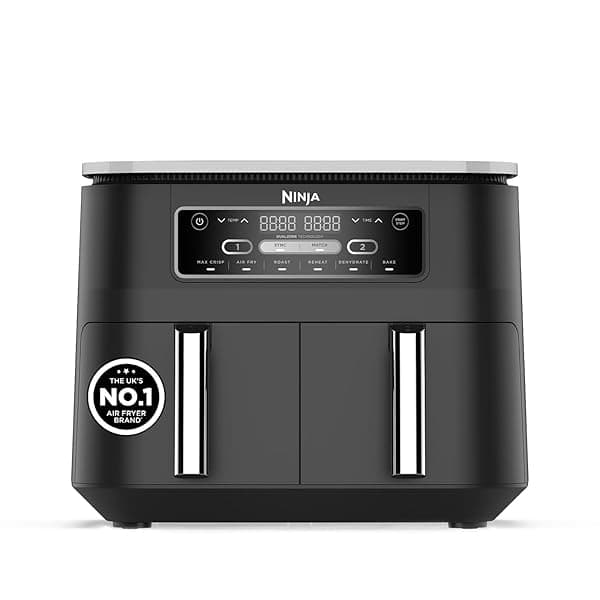
Best mid-size dual-zone for couples and small familiesNinja Foodi Dual Zone Digital Air
The Ninja AF300UK gives you 7.6 litres and the same 6-in-1 dual-zone functionality as its larger sibling, currently priced at £149.99. It handles four to six portions and its two independent baskets mean you can sync finish times across different dishes.
Best budget dual-basket fryer for larger householdsTower
The Tower Vortx Vizion offers a 9-litre dual basket with 10 one-touch presets and a digital control panel, currently at £79.93, well below its 90-day high of £142.08. For households that want dual-zone capacity without the Ninja price tag, this is the most practical alternative.
Best compact single-drawer fryer for two peopleRussell Hobbs Air Fryer
Russell Hobbs' 4.3-litre digital air fryer draws just 1.3 kW, making it one of the lower-running-cost options in this category on UK 240V mains. Nine cooking functions cover air fry, bake, roast, grill, and keep warm, with a temperature range of 40 to 200°C. At £52.99, it sits neatly between the Chefman mini and the larger dual-zone models, and its compact footprint suits a 600 mm worktop without overhanging. Dishwasher-safe attachments keep cleaning straightforward.
Frequently asked
What size air fryer do I need for a family of four?
For four people, aim for at least 7 litres of capacity. A 7.6-litre model like the Ninja AF300UK can cook four to six portions in one go. If you want to cook two different dishes simultaneously, a dual-zone fryer of 7.6 litres or above is the practical choice. Single-drawer models below 6 litres will require you to cook in batches, which adds time and means the first batch cools while the second cooks.
How much does an air fryer cost to run in the UK?
Running cost depends on wattage and cook time. Air fryers are still cheaper to run than a conventional oven for most meals because they preheat in two to three minutes and the cooking chamber is much smaller. Over a year of daily use, the difference between a 1.3 kW and a 2.7 kW model could be £20 to £40.
Are air fryer baskets really dishwasher safe?
Most baskets in this price range are labelled dishwasher-safe, but the nonstick coating can degrade faster with repeated dishwasher cycles, particularly in hard-water areas like London, the South East, and the Midlands where limescale deposits are common. Hand-washing with warm soapy water and a soft sponge is gentler and extends the life of the coating. If you do use a dishwasher, place baskets on the top rack and avoid high-temperature programmes.
Is a dual-zone air fryer worth the extra cost?
For most households cooking varied meals, yes. Dual-zone models let you run two baskets at different temperatures and times, then sync them to finish together. That means chips and chicken wings ready at the same moment, without juggling oven shelves. The Ninja AF300UK (£149.99) and Tower Vortx Vizion (£79.93) both offer this at different price points. If you mostly reheat single portions or cook one item at a time, a single-drawer model is perfectly adequate and takes up less worktop space.
What wattage air fryer should I buy for a UK home?
UK mains runs at 240V, and air fryers here typically range from 1.3 kW to 2.7 kW. For a compact 2 to 4-litre fryer used by one or two people, 1.3 kW to 1.5 kW is sufficient and keeps running costs lower. For a 7.6-litre or larger dual-zone model feeding a family, 1.7 kW to 2.4 kW is typical and provides faster, more even cooking. Higher wattage is not always better: a well-designed 1.5 kW fryer can outperform a poorly designed 2.4 kW one.