
This guide is for anyone in a hard-water area, where limescale will clog an unfiltered kettle within weeks. Every kettle here includes a removable, washable anti-scale filter and runs on the UK's 240V mains, most at 3kW for a fast boil, with glass and stainless-steel finishes toward the upper end. Below, we break down filter design, wattage, capacity and material so you can match a kettle to your household and your water.
What to look for
01Anti-scale filter quality and how easy it is to clean
A removable, washable mesh filter is the minimum you should accept in a hard-water area (broadly the South East, East Anglia, and the Midlands), since it catches limescale flakes before they reach your mug and rinses clean under the tap in seconds, without any tools. Look for filters described as 'removable and washable' rather than fixed gauze, which tends to clog and cannot be descaled properly. Descaling the kettle itself every four to six weeks with a proprietary descaler or a solution of white vinegar and water (roughly 50 ml vinegar to 500 ml water) will extend element life significantly. A pull-off or push-button lid makes this job far less fiddly than a hinged lid that traps your hand inside a hot kettle.
02Wattage and boil time on UK 240V mains
The UK's 240V, 13-amp plug supplies enough power to run a 3kW kettle element, which is the fastest you will find in a domestic jug kettle. At 3kW, a full 1.7L takes roughly three minutes to reach 100°C; a half-full kettle boils in under two minutes. The only exception in this guide is the Russell Hobbs travel kettle, which runs at 1kW because it is designed for dual-voltage use abroad (100V to 240V). For everyday home use, always choose 3kW if speed matters. Lower-wattage models (sometimes sold as 'quiet boil' at around 2.2kW) are slower but can suit open-plan kitchens where noise is a concern. Wattage does not affect running cost per boil in any meaningful way, since a faster boil uses the same energy as a slower one to heat the same volume of water.
03Capacity: matching the kettle to your household
Most kettles in this guide hold 1. 7L, which is the standard UK jug size and fits comfortably under a 600mm-high wall cupboard. That capacity makes roughly six to seven mugs per fill, enough for a family or a small office. Boiling only what you need is the energy-efficient habit to build, and a clear water window (or a glass body) makes it easy to fill accurately. If you regularly travel or use a caravan, the Russell Hobbs 0.85L travel model is worth considering: its smaller footprint and dual-voltage design make it practical on the Continent or at a UK campsite, though it will feel slow at home on 1kW. For a solo household, even a 1.7L kettle is fine as long as you fill it to the minimum line (usually around 500 ml) rather than to the top every time.
04Material: plastic, glass, or stainless steel
Plastic kettles dominate the budget end of the market and are perfectly safe, provided they are BPA-free. They are lighter and less likely to shatter if knocked, which matters if your worktop is at an awkward height. Glass kettles let you see limescale build-up at a glance, which is genuinely useful in a hard-water area because you know exactly when to descale. The downside is that glass is heavier when full and can feel fragile. Stainless steel interiors resist staining and are easier to wipe clean, though the exterior can show fingerprints. For hard-water households, glass or a stainless interior is the most practical choice because limescale is visible and easier to monitor.
Our top picks
Best for filter maintenanceRussell Hobbs Textures Electric 1.7L Cordless
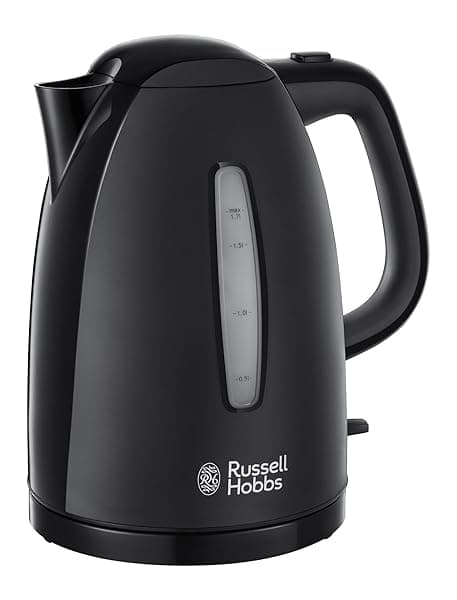
This 1.7L Russell Hobbs runs at 3kW and pairs a removable, washable anti-scale filter with a push-to-open lid, so lifting the filter out for a weekly rinse takes seconds rather than a fiddle with a hinge. The perfect-pour spout keeps limescale flakes out of your mug even between cleans. For a hard-water household that wants a straightforward jug kettle without a premium finish, this covers the essentials: fast 3kW boil, easy-access filter, standard 1.7L capacity.
Best glass kettle for watching limescaleChefman Glass Electric Kettle 1.8L 3000W
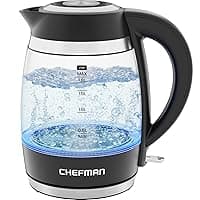
An 1.8L glass body at 3000W, slightly larger than the standard 1.7L jug, with auto shut-off as a safety backstop once it reaches boiling point. Glass construction means you can see scale forming on the element through the side, which is the easiest way to judge when a hard-water kettle needs descaling. BPA-free construction and a visible water window make it simple to fill accurately without lifting the lid.
Best stainless-steel finishCosori Kettle
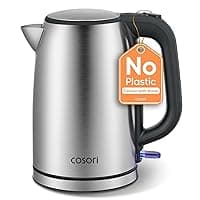
Brushed stainless steel resists fingerprints and scratches better than glossy plastic, and this Cosori model uses plastic-free water contact, meaning nothing but metal touches the water as it heats. It suits a kitchen where matching stainless appliances matter, and the finish wipes clean without the streaking that glass can show. A solid choice for anyone who wants a durable, easy-to-clean exterior alongside the standard anti-scale filtering this guide requires.
Best for travel and dual-voltage useRussell Hobbs Electric 0.85L Travel Kettle
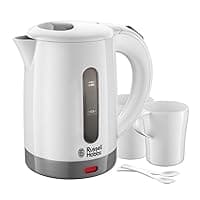
At 0.85L and 1000W, this Russell Hobbs is built for dual-voltage use between 100V and 240V, making it the only kettle here suited to travel abroad or caravan trips rather than daily home use. Its compact footprint takes up a fraction of the worktop or cupboard space a full-size 1.7L kettle needs. Expect a noticeably slower boil than the 3kW models in this guide, since 1000W is roughly a third of the power.
Best budget option with boil-dry protectionDaewoo Essentials 1.7L Fast Boil Electric
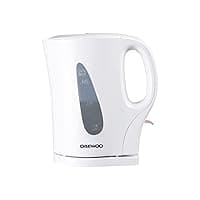
A straightforward 1.7L plastic jug kettle with auto shut-off and boil-dry protection built in, so the element cuts out if it is switched on empty or runs low. It is the simplest kettle in this guide, cordless and easy to wipe down, aimed at anyone who wants reliable everyday boiling without extra features like a filter viewing window. Pair it with a weekly filter rinse and a monthly descale in a hard-water area.
Frequently asked
How often should I descale my kettle in a hard-water area?
In a hard-water area such as London, Kent, or the East Midlands, descale every four weeks if you use the kettle daily. Fill it to the halfway mark with a solution of one part white vinegar to two parts cold water (roughly 50 ml vinegar to 100 ml water), boil, leave for 20 minutes, then rinse thoroughly two or three times. Proprietary descaler tablets work equally well and leave less odour. Rinsing the removable anti-scale filter weekly under the tap slows build-up between full descales.
Is a 3kW kettle more expensive to run than a lower-wattage model?
No. A 3kW kettle boils water faster than a 2.2kW model, but it uses the same amount of energy to heat the same volume of water to 100°C. Energy consumption depends on the volume of water and the temperature rise, not the wattage. The only way to reduce running costs is to boil only as much water as you need. On the UK's 240V mains, a 3kW element is the most efficient choice because it minimises the time the element is on.
What is the difference between a fixed filter and a removable washable filter?
A fixed filter is a gauze built into the spout that cannot be taken out. It catches large limescale flakes but clogs over time and cannot be cleaned properly. A removable washable filter lifts out entirely, so you can rinse it under the tap, scrub off limescale deposits, and refit it in seconds. In a hard-water area, a removable filter is strongly preferable because it stays effective for longer and extends the life of the kettle.
Can I use a travel kettle as my main home kettle?
You can, but it is not ideal. A dual-voltage travel kettle typically runs at 1kW on a UK 240V plug, compared with 3kW for a standard home kettle. That means boiling a small 0.85L capacity takes roughly three times as long as a full-size 3kW model boiling the same volume. For a single person who makes one or two cups at a time, the slower boil is tolerable. For a family or anyone who boils frequently, the wait becomes frustrating quickly.
Is a glass kettle better than a plastic one for hard-water areas?
Glass has one clear practical advantage in a hard-water area: you can see limescale forming on the element without opening the lid. That makes it easier to judge when to descale. Plastic kettles hide internal build-up until it is quite advanced. On the other hand, glass is heavier when full and more fragile. A stainless steel interior is a good middle ground: it resists staining and is easy to wipe clean, though you cannot see through it. All three materials are safe to use.