
Oven-safe tableware is not a universal standard: stoneware, porcelain, borosilicate glass and certain plastics each have distinct upper temperature limits, and UK kitchens need pieces that can move from a 220°C fan oven to the table without cracking. This guide explains the material differences, what to check on the base of any piece, and which sets suit everyday use.
What to look for
01Temperature ceiling and material type
The single most important marking on any oven-safe piece is its maximum temperature ceiling, expressed in °C. Stoneware and porcelain are typically approved to 220-260°C, which covers most UK fan-oven cooking. Borosilicate glass handles thermal shock better than standard soda-lime glass and is usually approved to around 300°C. Earthenware is more porous and often limited to 180°C or lower. Always check the base of the piece or the manufacturer's data sheet for the specific figure. A symbol showing an oven icon with a temperature number is the clearest indicator. If no figure appears, treat the piece as oven-unsafe. Glazed ceramics without a stated limit may contain lead-based glazes that can leach at high heat, so an explicit marking matters for food safety as well as durability.
02Thermal shock resistance
Thermal shock occurs when a cold piece is placed directly into a hot oven, or a hot piece onto a cold surface. Thin-walled porcelain is more vulnerable than thick stoneware. Borosilicate glass has a very low coefficient of thermal expansion, making it the most resistant of common tableware materials. As a practical rule, always bring ceramic pieces to room temperature before placing them in a preheated oven, and rest hot pieces on a folded tea towel rather than a cold granite worktop. UK kitchens with stone or tiled surfaces are particularly prone to causing thermal-shock cracks. Pieces labelled 'oven-to-table' have been tested for this transition, but the label does not specify a temperature, so cross-reference with the manufacturer's stated limit.
03Dishwasher and microwave compatibility
Oven-safe does not automatically mean dishwasher-safe or microwave-safe, and the three properties are independent. Dishwasher-safe ceramics use glazes that resist repeated exposure to 65°C wash cycles and alkaline detergents. Pieces with metallic trim, gold banding or hand-painted decoration are rarely dishwasher-safe even if the base ceramic is oven-safe. For microwave use, the key requirement is that the material does not absorb microwave energy and heat up independently of the food. Most plain stoneware and porcelain passes this test; metallic glazes and some earthenwares do not. Check for separate oven, microwave and dishwasher symbols on the base, and treat each as a distinct specification rather than assuming one implies the others.
04Microwave-safe versus oven-safe: the key distinction
A common source of confusion is the difference between microwave-safe and oven-safe specifications. Microwave-safe means the material does not absorb microwave radiation and will not heat up or warp during microwave use. Oven-safe means the material can withstand sustained dry heat, typically from 180°C to 260°C, without cracking, warping or releasing harmful compounds. A piece can be one without being the other. Plastic dinnerware, for example, may carry a microwave-safe mark at low power settings but will warp or melt in a conventional oven. Conversely, some stoneware is oven-safe but contains metallic oxides in the glaze that cause arcing in a microwave. Always read both symbols independently on any piece you intend to use in both appliances.
05Sizing and weight for UK kitchens
Standard UK dinner plates run 26-28cm in diameter, and most British ovens have an internal width of around 40-45cm, so a set of four plates can usually sit side by side on one shelf. Weight matters too: a stoneware dinner plate typically weighs 600-900g, so a full set of eight can be heavy to lift in and out of a hot oven. Thinner porcelain plates, around 300-500g each, are easier to handle but may need more careful thermal management. Check the stated dimensions in the product listing before buying, particularly if you have a compact under-counter oven or a range cooker with shallower shelves. Bowls intended for oven use should have a flat, stable base to prevent tipping on oven racks.
Our top picks
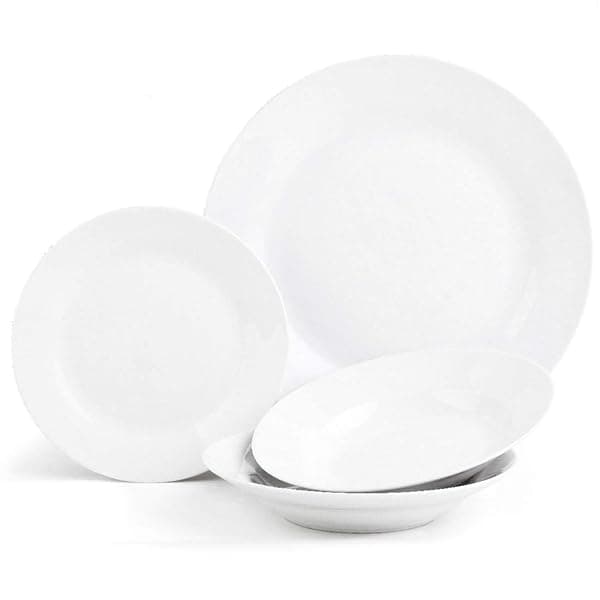
Best for everyday oven-to-table useSabichi Dinner Set 12 Piece White

The Sabichi 12-piece set covers four place settings with plates, bowls and mugs, all certified microwave-safe and dishwasher-safe. The plain white glaze contains no metallic trim, so there is no conflict between microwave and oven use. The vitrified ceramic construction gives good resistance to chipping on UK hard-water areas where limescale can stress glaze surfaces. A practical, unfussy set for households that want pieces they can move between oven, microwave and dishwasher without checking labels each time.
Best cutlery to pair with oven-safe dinnerwareEXZACT 24pcs Stainless Steel Cutlery Gingham
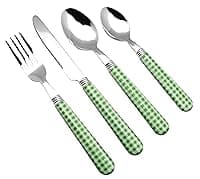
EXZACT's 24-piece set in 18/0 stainless steel covers six place settings with four pieces each. Stainless steel cutlery is unaffected by oven heat and dishwasher cycles, making it a durable match for ceramic oven-to-table sets. The gingham resin handles are not oven-safe themselves, but the steel blades, tines and bowls are. A sensible, corrosion-resistant choice for UK households in hard-water areas where cheaper alloys pit quickly in the dishwasher.
Best for outdoor and camping use48pcs Unbreakable Dinnerware Sets for 4

This 48-piece set for four covers plates, bowls, cups and cutlery in lightweight, unbreakable plastic. The material is not oven-safe, but it is the right choice for camping, picnics and BBQs where breakage and weight are the primary concerns. At 48 pieces for four people, the count is generous enough to handle a full outdoor meal without reusing items. The colourful construction makes it easy to assign pieces to individuals, useful for families with young children.
Best for larger families eating outdoors62pcs Unbreakable Dinnerware Sets for 5
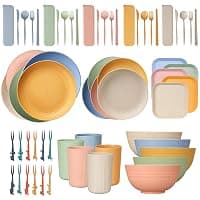
The 62-piece CSYY set scales up to five people and adds extra serving pieces to the 48-piece configuration. Lightweight plastic construction keeps the total pack weight low enough for rucksack or car-boot transport. Like the four-person version, this is not oven-safe, but the colourful plates and bowls are designed for outdoor use where durability and portability outweigh the need for high-heat tolerance. A practical choice for families who eat outdoors regularly through the UK summer.
Best kids' set for daily mealtimesBluey Kids 6 Piece Reusable Dinner
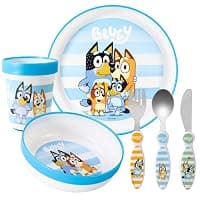
The Bluey 6-piece reusable set includes a cup, bowl, plate and cutlery sized for small hands. The reusable, BPA-free plastic construction is dishwasher-safe, which matters for busy households. It is not oven-safe, but children's tableware rarely needs to be. The licensed Bluey design encourages reluctant eaters to sit at the table, and the compact dimensions fit neatly in a 600mm base-unit cupboard alongside adult dinnerware.
Best kids' set for Minnie Mouse fansMinnie Mouse Kids 6 Piece Reusable
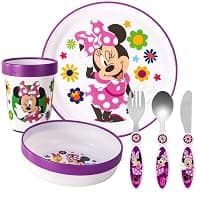
Minnie Mouse 6-piece reusable set mirrors the Bluey set's construction and piece count, with the same cup, bowl, plate and cutlery configuration. Reusable BPA-free plastic and dishwasher-safe finish make it a low-maintenance option. The compact plate diameter suits toddler and primary-school-age portions. Useful as a second character-themed set in households with children who have different preferences, avoiding mealtime disputes over whose plate is whose.
Best for protecting the table from hot oven dishesArgon Tableware 12 Piece Rectangular Slate
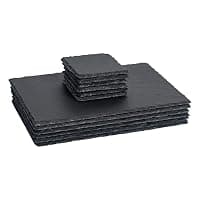
Argon Tableware's 12-piece set includes six natural slate placemats and six matching coasters. Slate is a dense, heat-resistant stone that handles hot ceramic and cast-iron dishes coming straight from a 220°C oven without warping or scorching. Each placemat is rectangular, sized to sit under a standard 28cm dinner plate with room for cutlery. A practical complement to any oven-to-table ceramic set, and the natural black finish suits both casual and formal table settings.
Best cloth napkins for oven-to-table diningEncasa XO Cotton Cloth Napkins

Encasa XO's cotton dinner napkins measure 43cm x 43cm (17 x 17 inches), a generous size that covers a lap properly. 100% cotton construction means they launder at 60°C, which is the standard UK hot wash for kitchen linens. Cotton also handles brief contact with warm ceramic surfaces without melting, unlike synthetic napkins. A set of cloth napkins elevates an oven-to-table meal without adding complexity, and cotton softens with each wash rather than pilling.
Frequently asked
How do I know if my plates are oven-safe?
Check the base of each piece for an oven symbol, which looks like a square with a wavy line or a temperature figure inside. If a specific °C figure appears, that is the maximum safe temperature. If no symbol is present, the manufacturer's product page or packaging should state the limit. Pieces with gold, silver or metallic banding are almost never oven-safe regardless of what the base ceramic can handle, because the metallic decoration can crack or discolour at oven temperatures.
Can I put stoneware straight from the fridge into a hot oven?
No. Moving stoneware directly from fridge temperature (around 4°C) into a preheated oven at 200°C or above creates a rapid temperature differential that can crack even oven-safe pieces. Allow the piece to reach room temperature first, which takes around 20-30 minutes on a kitchen worktop. This is especially important in UK homes with cold stone or tiled surfaces, where pieces cool down faster than in warmer climates.
Is plastic dinnerware ever oven-safe?
Standard polypropylene and melamine plastics are not oven-safe. They begin to warp at temperatures above 120°C and can release compounds at higher temperatures. Some specialist silicone bakeware is oven-safe to around 230°C, but this is a distinct material from the plastic used in everyday dinnerware sets. If a plastic dinnerware set does not explicitly state an oven-safe temperature on the packaging, treat it as oven-unsafe and use it only for cold or microwave-reheated food.
What is the difference between vitrified and standard ceramic?
Vitrified ceramic is fired at a higher temperature, typically above 1,200°C, which fuses the clay particles into a denser, less porous structure. This makes it more resistant to chipping, staining and thermal stress than standard earthenware fired at lower temperatures. Most commercial restaurant-grade dinnerware is vitrified. For home use, vitrified pieces are a better long-term investment if you plan to use them in the oven regularly, as the denser body handles repeated heating and cooling cycles more reliably.
Are slate placemats heat-resistant enough for oven dishes?
Natural slate is a metamorphic rock with good thermal mass, meaning it absorbs and distributes heat rather than conducting it rapidly to the table surface beneath. It can handle a ceramic casserole dish or roasting tin coming straight from a 220°C oven without cracking or scorching. However, very heavy cast-iron cookware at extreme temperatures can cause thin slate to crack over time, so use a folded cloth beneath cast iron for extra protection. Slate placemats are not a substitute for a proper trivet with very heavy pans.