
An air fryer typically draws 1,150W to 2,400W or more on the UK 240V mains, and wattage is the single biggest lever on what it costs to run. Using the Ofgem price cap of 26.11p per kWh (1 Jul to 30 Sep 2026, Direct Debit, GB average), a duty-cycled appliance like an air fryer costs less per cook than its nameplate wattage suggests, because the element cycles on and off once up to temperature. This guide breaks down what capacity and wattage mean for your bill.

What to look for
01Wattage and cost per session
Wattage is the starting point for any running-cost estimate, and on the UK 240V supply it varies a lot by basket size. The Midea Compact 2L draws 1,150W, while larger dual-zone and multi-function models typically run 2,100W to 2,650W; the HYSapientia 22L oven-style unit draws 2,400W. Using the Ofgem price cap of 26.11p per kWh (1 Jul to 30 Sep 2026, Direct Debit, GB average), a 20-minute cook at 1,150W works out to roughly 10p on nameplate wattage, and a 20-minute cook at 2,400W works out to roughly 21p. Treat both as an upper-bound estimate, not a measured figure: an air fryer's element cycles on and off once it reaches temperature, so a plate-power calculation of watts times minutes overstates real consumption. The standing charge (57.19p per day on the same tariff) is billed whether or not you cook, so it is excluded from per-use figures above. Matching wattage to your actual portion size is what stops you paying to heat air you don't need.
02Capacity and portion size
Buying too large a basket wastes electricity on every cook; buying too small forces you to run two batches, which can use more energy than a bigger fryer would have needed in one pass. As a rough guide: a 2L basket suits one person, 5L covers a couple, 7 to 8L handles a family of four, and 9L or more suits batch cooking or larger households. The Ninja Foodi Dual Zone at 7.6L splits that volume across two independently controlled drawers, which is the sweet spot for most UK families. The Tefal Easy Fry Dual Zone at 8.3L covers a similar footprint with 8 programmes. If your worktop is tight, measure first: standard UK base units run around 600mm deep, and the largest dual-zone units, such as the 10.4L Ninja Foodi FlexDrawer, are substantial appliances.
03Dual-zone versus single-basket efficiency
Dual-zone fryers let you cook two different foods at different temperatures at once, which draws more watts when both zones are running, but it replaces two separate cooking sessions, such as a fryer plus an oven side dish. If you'd otherwise run a single-basket fryer and then use the oven for a second component, a dual-zone model such as the Ninja Foodi Dual Zone or the Tefal Easy Fry Dual Zone usually wins on total energy use. The real question is whether you regularly cook two-component meals. If you mostly do one item at a time, chips or reheating for example, a lower-wattage single-basket unit like the Midea Compact 2L or the Tefal Easy Fry Max 5L will cost less to run per session and takes up less worktop space too.
04Hard-water areas and long-term maintenance
This factor is easy to overlook, but if you live in a hard-water area, roughly two-thirds of England, including London, the South East, and the Midlands, limescale can affect any appliance that uses steam or moisture. Air fryers themselves are not directly affected by limescale, but the dishwasher you use to clean the baskets is. All the models in this guide have dishwasher-safe baskets, which is convenient, but running a full dishwasher cycle for one basket is rarely efficient. Hand-washing non-stick baskets in warm water takes under two minutes and extends the coating's life, keeping the fryer performing at full efficiency for longer.
05Matching capacity to household size avoids double buying
The cheapest air fryer to buy is not always the cheapest to own. Compact 2L to 5L single-basket models generally sell in the lower part of the market, while 7L to 10.4L dual-zone and multi-function models sit higher, reflecting the extra motor, drawer and control hardware involved. If a solo cook buys a small basket and upgrades within months because it's too small, the combined spend and the electricity used cooking multiple batches both add up. Equally, buying a large dual-zone or 22L oven-style unit for a one-person household is hard to justify on running-cost grounds, since a bigger cavity generally means a higher wattage even when duty-cycled. Buying the right capacity for your household size the first time is the single biggest saving available, ahead of any difference between brands.
Our top picks
Best for solo cooks and small kitchensMidea Compact 2L Air Fryer

Drawing 1,150W, the lowest draw of any model in this guide, the Midea Compact 2L keeps both the purchase footprint and the running cost down for one-person households. Its 2L basket matches a single portion without wasted capacity, and it comes with 12 preset menus and a dishwasher-safe non-stick basket. The compact space-saving design suits a tight UK kitchen worktop where a large dual-zone unit wouldn't fit, and the lower wattage means every cook costs less on the meter than a larger model doing the same job.
Best single-basket for couplesTefal Easy Fry Max 5L Air

The Tefal Easy Fry Max steps up to a 5L basket, sized for two people without moving into dual-zone territory, and runs 10 auto programmes from a digital display. Keeping to a single zone means lower overall wattage than the dual-zone models here, so it suits households that mostly cook one dish at a time rather than two components simultaneously. It's a sensible middle step between a compact 2L unit and a full dual-zone model.
Best dual-zone for a family of fourNinja Foodi Dual Zone Digital Air
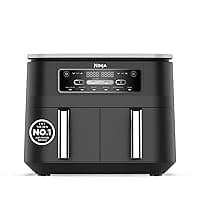
The Ninja Foodi Dual Zone (AF300UK) splits 7.6L across two independently controlled drawers with 6-in-1 functions, letting you run chips in one zone and protein in the other at different temperatures without needing a second appliance. That capacity sits at the sweet spot for a family of four cooking a full meal in one pass. Baskets are dishwasher-safe non-stick, which matters if you're cleaning it daily.
Best value dual-zoneTefal Easy Fry Dual Zone 8.3L
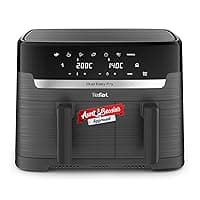
The Tefal Easy Fry Dual Zone offers 8.3L across two zones with 8 programmes, a larger drawer volume than the Ninja AF300UK, in a grey digital-control unit. It's worth considering if you want dual-zone flexibility, cooking two components at different temperatures, without stepping up to Ninja's largest models. The extra capacity over a 7.6L unit suits families who batch cook regularly.
Best for flexible batch cookingNinja Foodi FlexDrawer Air Fryer
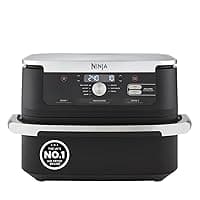
The Ninja Foodi FlexDrawer holds 10.4L with a removable divider, so it works as one large single basket for batch cooking or splits into two zones for dual-temperature meals, with 7-in-1 functions. That flexibility suits households of five or more, or anyone who batch-cooks for the week ahead. It's the largest and heaviest model here, so check your worktop depth, standard UK base units run around 600mm, before buying.
Frequently asked
How much does an air fryer cost to run per month in the UK?
On the Ofgem price cap of 26.11p per kWh (1 Jul to 30 Sep 2026, Direct Debit, GB average), a 1,150W air fryer used for 20 minutes daily costs roughly £3.00 a month on nameplate wattage, excluding the standing charge. A 2,400W model on the same schedule costs roughly £6.30 a month. Both figures are upper-bound estimates: air fryers are duty-cycled, meaning the element switches off once up to temperature, so real consumption is lower than watts-times-minutes suggests. If you cook twice a day or for longer sessions, scale the figures up accordingly.
Is a dual-zone air fryer more expensive to run than a single-basket model?
A dual-zone fryer draws more watts when both zones are active, but it replaces two separate cooking sessions. If you'd otherwise run a single-basket fryer and then use the oven or a second appliance, the dual-zone approach typically uses less total energy. The saving depends on how often you actually cook two components at once. For solo cooks or couples who mostly do one-item meals, a lower-wattage single-basket model, such as the 1,150W Midea Compact 2L, will cost less to run day to day.
What size air fryer do I need for a family of four in the UK?
For four people, aim for 7L to 9L of capacity. The Ninja Foodi Dual Zone at 7.6L splits that across two independently controlled drawers, which fits most UK kitchen worktops. If you batch cook or have hungry teenagers, step up to an 8.3L or larger dual-zone model, such as the Tefal Easy Fry Dual Zone, or a 10L-plus unit like the Ninja Foodi FlexDrawer. Going smaller than 6L for a family of four usually means running two batches, which erodes the time and energy savings that make air fryers worthwhile.
Do air fryers use a lot of electricity compared with a microwave?
Air fryers use more electricity than microwaves for equivalent reheating tasks. A microwave's advertised wattage is its output, not its input draw, and typically pulls somewhere around 1,000W to 1,300W from the wall; an air fryer's nameplate wattage of 1,150W to 2,400W is closer to what it actually draws, since it's a resistive heating element rather than a magnetron. Air fryers produce crisp results a microwave cannot replicate, so for texture-dependent food, chips, pastries, battered fish, the extra pence per session is usually worth it. For soup or rice, a microwave or hob uses less energy.
How accurate are air fryer running-cost estimates?
Any running-cost figure built from nameplate wattage times cooking time is an estimate, not a metered reading, and it should be treated as an upper bound. Air fryers are duty-cycled: the heating element switches off once the basket reaches temperature and cycles back on to maintain it, so a plate-power calculation overstates real consumption. The estimate is also tied to a specific tariff, the Ofgem price cap of 26.11p per kWh runs 1 Jul to 30 Sep 2026, and changes each quarter, so treat any cost figure, including the ones in this guide, as time-bound rather than fixed.