
The material your bakeware is made from shapes every bake you produce. Metal tins conduct heat rapidly and give you crisp, browned bases, while silicone moulds release sponges and muffins without greasing. With sets available from under £15 to around £46, there is a practical option for every UK kitchen, whether you bake weekly or just at Christmas.
What to look for
01Heat conductivity and browning performance
Metal bakeware, particularly carbon steel and stainless steel, conducts heat far more efficiently than silicone. In a standard UK fan oven running at 180°C, a metal tin reaches baking temperature almost immediately, which promotes the Maillard reaction that gives bread crusts and cake bases their colour and texture. Stainless steel, as used in the TEAMFAR 6-inch round tins, is slower to conduct than carbon steel but is entirely non-reactive, so it will not interact with acidic batters such as lemon drizzle or fruit cake. Silicone, by contrast, is a poor conductor. It insulates the batter from direct heat, which means bases can remain pale and slightly underdone unless you extend baking time or place the mould on a preheated metal tray. For anything where a golden crust matters, metal wins outright.
02Non-stick coatings and PFAS concerns
Many UK bakers are now paying close attention to coating chemistry. PTFE-based non-stick coatings are effective but have faced scrutiny over PFAS compounds. Several products in this guide address that directly. The MasterClass 7-piece set is marketed as PFAS-free, and the Dawsons Living roasting tray set is explicitly labelled Lead, PFAS and PTFE free. Silicone bakeware, such as the Acidea 7-piece set, sidesteps the coating question entirely because the material itself is inherently non-stick and BPA-free. If you live in a hard-water area, note that mineral deposits can degrade non-stick coatings faster, so PFAS-free or uncoated stainless steel may last longer. Always check whether a tin is dishwasher safe before buying, as repeated dishwasher cycles strip coatings on cheaper trays.
03Sizing and UK kitchen storage
Standard UK ovens have an internal width of roughly 40 to 45 cm, so a 38 cm baking tray, such as the largest in the Kitcheneur 4-pack, fits comfortably on a single shelf with room for air circulation. The Homealexa silicone mat set includes 40 cm diameter round liners and 36 x 42 cm rectangular sheets, which cover most standard UK baking trays. Stackable designs matter enormously in smaller kitchens: the MasterClass 7-piece set and the Dawsons Living 3-piece roasting set are both described as stackable, which keeps a 600 mm base cupboard organised. If you bake layered cakes, the TEAMFAR set gives you four identical 6-inch (15 cm) round tins, so all layers bake simultaneously rather than in batches.
04Durability and cleaning
Stainless steel is the most durable material in this category. It does not warp under high heat, does not scratch if you use metal utensils, and can go in the dishwasher indefinitely. The TEAMFAR cake tins are stainless steel and carry no coating to degrade. Carbon steel trays with non-stick coatings, such as those in the Kitcheneur sets, are dishwasher safe according to the manufacturer, but hand washing in warm soapy water extends coating life considerably. Silicone is flexible and virtually indestructible under normal use, but it can absorb strong odours over time and should be washed thoroughly after baking anything with garlic or spice. Reusable silicone mats, like the Homealexa liners, replace single-use baking parchment and can be wiped clean in seconds, making them one of the most practical additions to any baking kit.
05Choosing by baking type
Match the material to what you actually bake. For roasting vegetables or cooking traybakes, a deep-sided metal tray, such as the Dawsons Living 3-piece set, gives you the rigidity and browning you need. For delicate sponges, bundt cakes, or muffins where release is the priority, silicone moulds like the Acidea 7-piece set are genuinely useful. For bread, pastry, and anything needing a crisp base, metal is non-negotiable. Reusable silicone mats sit underneath metal trays and prevent sticking without affecting browning the way a thick silicone mould would. If you want one set that covers most tasks, a stackable metal multi-piece set with a PFAS-free coating, combined with a set of reusable liner mats, covers the widest range of everyday baking.
Our top picks
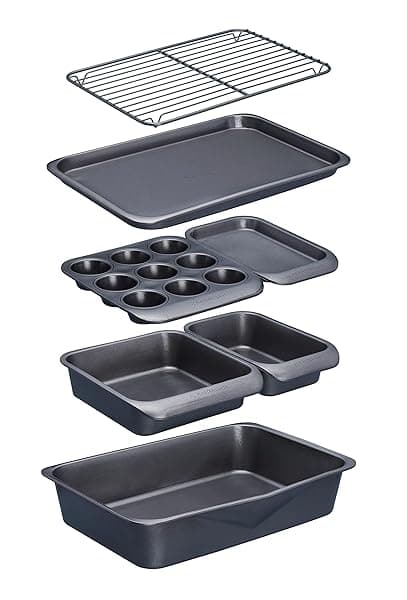
Best for everyday bakers who want a complete PFAS-free setMasterClass Smart Space Stackable 7 Piece
Seven stackable pieces in a PFAS-free, PTFE-free and BPA-free non-stick finish give you a genuinely comprehensive starting point without chemical coating concerns. The stackable design keeps a standard 600 mm cupboard tidy, and the set spans the most common baking tasks from loaf tins to flat trays. A solid choice if you are equipping a kitchen from scratch and want one purchase to cover most bases.
Best budget tray set for high-volume baking4-Pack

Four 32 cm non-stick trays in a single pack give you enough capacity to bake multiple batches simultaneously, which matters if you are producing biscuits, flapjacks, or roasted vegetables for a family. Dishwasher-safe construction keeps cleaning straightforward. The 32 cm length fits comfortably inside standard UK fan ovens with clearance on both sides for proper air circulation.
Best deep roasting tray set for Sunday roasts and traybakesSet of 3 Premium Non-Stick Deep
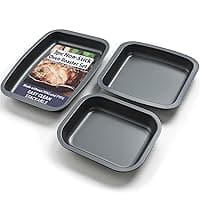
Three deep-sided, stackable roasting trays with a Lead, PFAS and PTFE-free finish address the growing demand for cleaner coating chemistry. The deep sides contain juices during roasting and support high-sided traybakes. Dishwasher-safe and stackable, this set is practical for kitchens where storage space is limited and the oven sees regular weekend use.
Best for layered celebration cakesTEAMFAR 6 Inch Cake Tin Set
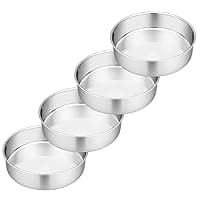
Four identical 6-inch (15 cm) stainless steel round tins let you bake all layers of a celebration cake in a single oven run, cutting total baking time significantly. Stainless steel is non-reactive, so acidic fruit batters and lemon sponges will not pick up any metallic taste. The material requires no coating and will not degrade in the dishwasher over years of use.
Best for bakers who also need oven racksSet of 3 Roasting Baking Tin

Three non-stick trays paired with three matching racks give you the option to roast meat on a raised rack with drip collection below, or to cool baked goods directly on the rack without transferring to a separate wire stand. The combined tray-and-rack format is particularly useful in smaller kitchens where storing separate cooling racks is impractical.
Best mixed-size tray set for varied baking tasks4-Pack

Three baking tray sizes, 38 cm, 35 cm, and 28 cm, plus a 28 cm roasting tray, cover the full range from full-sheet biscuit baking to smaller brownie batches. All four are non-stick and dishwasher safe. Having graduated sizes means you can match the tray to the recipe rather than using a large tray for a small bake, which affects heat distribution and browning.
Best silicone set for muffins, loaves, and flexible bakingAcidea Nonstick Silicone Bakeware Set
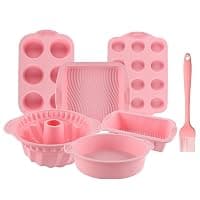
Seven BPA-free silicone pieces, including loaf, muffin, and round cake moulds, release baked goods without greasing and flex to pop out even delicate sponges cleanly. Heat resistant to temperatures suitable for standard UK ovens, the set includes a silicone brush for any light greasing needed. Placing the moulds on a rigid metal tray before filling prevents spillage and improves base browning.
Frequently asked
Is silicone or metal bakeware better for cakes?
For most cakes, metal tins produce better results. Metal conducts heat efficiently in a UK fan oven, giving you a properly risen sponge with a lightly browned base. Silicone insulates the batter, which can leave bases pale and slightly sticky unless you extend baking time or place the mould on a preheated metal tray. Silicone does excel at release, so it suits intricate moulds, muffins, and bundt shapes where getting the bake out cleanly is the main challenge.
Are PFAS-free baking trays actually better?
PFAS-free trays remove a category of synthetic compounds that have attracted regulatory attention in the UK and EU. Whether the performance difference is noticeable in everyday baking is debatable. PFAS-free coatings can be slightly less slippery than traditional PTFE, so you may need to lightly grease the tin. Stainless steel bakeware avoids the question entirely because it carries no coating at all. If coating chemistry concerns you, look for trays explicitly labelled PFAS-free or PTFE-free, or choose uncoated stainless steel.
What size baking tray fits a standard UK oven?
Most standard UK built-in ovens have an internal width of 40 to 45 cm and a depth of around 40 cm. A 38 cm baking tray fits comfortably on a single shelf with space for air to circulate around the edges, which is important for even baking in a fan oven. Trays wider than 40 cm may fit the shelf but restrict airflow. Always measure your oven's internal cavity before buying a full set, particularly if you have a compact or under-counter model.
Can I put non-stick baking trays in the dishwasher?
Many non-stick trays are labelled dishwasher safe, and several in this guide, including the Kitcheneur sets and the Dawsons Living roasting trays, carry that claim. In practice, repeated dishwasher cycles, particularly with harsh UK water and high-temperature programmes, degrade non-stick coatings faster than hand washing. If you want your trays to last several years, washing by hand in warm soapy water is the better habit. Stainless steel tins, such as the TEAMFAR cake tins, are genuinely dishwasher-proof with no coating to protect.
Do I need to grease a silicone baking mould?
Silicone is inherently non-stick, so most recipes do not require greasing. For very delicate sponges or sticky batters, a light brush of oil or butter adds insurance. New silicone moulds should be washed before first use. One practical tip: always place a filled silicone mould on a rigid metal baking tray before putting it in the oven. This makes it safe to transfer, prevents the flexible sides from bowing outward, and puts the base in contact with conducted heat for better browning.
How many baking trays do I actually need?
For most UK home bakers, three to four trays covers everyday needs. Two flat trays handle biscuits and sheet bakes, one deep roasting tray manages vegetables and traybakes, and a smaller tray suits brownies or smaller batches. If you bake layered cakes regularly, four identical round tins let you bake all layers simultaneously. Multi-piece sets, such as the Kitcheneur 4-pack or the MasterClass 7-piece set, are cost-effective ways to reach that number without buying individual pieces.