
A coffee machine running at 1,450W every morning adds up faster than most people expect, but the right choice can cut your energy use significantly. This guide covers wattage, auto-off features, and real running costs across five machines priced from £39.99 to £699.99, so you can pick the most efficient option for your kitchen.
What to look for
01Wattage and daily running cost on UK mains
On the UK's 240V mains supply, a coffee machine's wattage rating tells you how much power it draws while heating up and brewing. The De'Longhi Magnifica ECAM222.20.B runs at 1,450W, which is typical for a bean-to-cup machine. At the current Ofgem unit rate of roughly 24p per kWh, a single 10-minute heat-up cycle costs around 0.6p. That sounds trivial, but machines left on standby for hours push the daily figure much higher. Look for models with an auto-off timer, ideally set to 15 or 30 minutes. Fully automatic machines like the Philips 3300 Series and De'Longhi Rivelia include programmable energy-saving modes. At the other extreme, the AeroPress Go uses zero electricity at all, making it the cheapest to run by a wide margin. If you brew only one or two cups a day, a manual brewer or a machine with a fast heat-up time and aggressive auto-off will cost far less to run annually than a machine left idling.
02Bean-to-cup grinders versus pod systems
Bean-to-cup machines grind fresh beans for every shot, which means the motor runs briefly each time. The Sage Barista Express and Barista Express Impress both include integrated burr grinders, adding a small extra draw on top of the boiler wattage. Pod machines, by contrast, skip the grinder entirely, so their active power draw is lower per brew cycle. However, pod machines often stay in a heated ready state between cups, which can offset that saving. The Philips 3300 Series uses a ceramic grinder, which runs cooler and more quietly than steel burr grinders, described by Philips as 40% quieter, and ceramic components tend to generate less friction heat. If you brew four or more cups a day, a bean-to-cup machine's per-cup energy cost becomes competitive with pod systems once you factor in the cost of the capsules themselves. CafePod capsules, for example, are currently £42.00 for 100, adding a running cost beyond electricity.
03Standby power and auto-off settings
Standby consumption is the hidden drain on your electricity bill. A machine drawing even 2W to 5W in standby for 20 hours a day adds roughly 35 to 88 kWh per year, costing £8 to £21 at current UK rates. The De'Longhi Magnifica Evo Next ECAM312.80.TB and the Rivelia EXAM440.55.G both feature intuitive touch displays with programmable auto-off, letting you set the machine to power down after a defined idle period. The Sage Barista Express Impress also includes an energy-saving mode. When comparing machines, check whether the auto-off is fixed or user-configurable. A fixed 3-hour auto-off is far less efficient than a user-set 15-minute timer for a household that brews only at breakfast. In hard-water areas such as London or the East Midlands, descaling frequency also affects efficiency: scale build-up forces the boiler to work harder and draw more power to reach brewing temperature.
04Size, capacity, and how they affect energy use
A larger water tank does not directly increase energy consumption, but a larger boiler does. Machines designed for high-volume output, such as the Sage Barista Express at £499.95, maintain a bigger thermal mass that takes longer to heat and longer to cool. For a one- or two-person household in a typical UK kitchen with 600mm-deep worktops, a compact machine with a smaller boiler is often more efficient. The De'Longhi Rivelia is marketed as compact despite its 16-recipe range, making it a reasonable choice if counter space and energy use both matter. The AeroPress Go is the smallest option here, fitting easily in a drawer, and its zero-watt operation means it has no boiler at all. For households that want hot espresso-style coffee with minimal electricity, pairing an AeroPress with an already-boiling kettle is the most energy-efficient route available.
Our top picks
Best for zero running costsAeropress Go Portable Travel Coffee Press
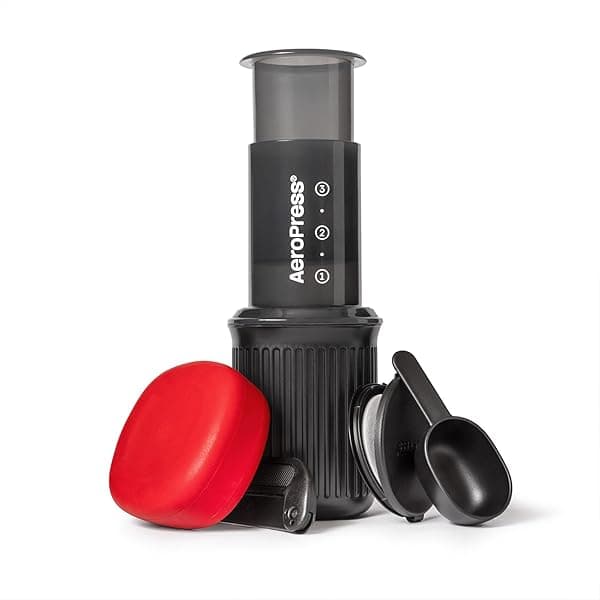
At £39.99 and currently above its 90-day low of £34.00, the AeroPress Go uses no electricity whatsoever. It brews one to three cups in under a minute using water from your kettle, produces a clean, low-acid cup, and packs into a 350ml mug for travel. If your priority is the lowest possible energy bill and you are happy to boil a kettle, nothing here comes close on running cost.
Best fully automatic with energy-saving modesPHILIPS 3300 Series Bean to Cup
The Philips 3300 Series EP3347/90 is currently £418.87, down from a 90-day high of £473.00, making this a reasonable moment to buy. Its ceramic grinder runs cooler than steel alternatives, and Philips rates it 40% quieter than previous models. The LatteGo milk frother is fully automatic and dishwasher-safe, reducing the temptation to leave the machine on between drinks while you clean up.
Best for barista-quality espresso with programmable efficiencySage Barista Express Impress
The Sage Barista Express Impress at £591.00 includes assisted tamping, a built-in burr grinder, and a manual milk frother, giving you cafe-standard espresso at home. Its energy-saving mode limits standby draw between sessions. The 90-day low of £580.00 means the current price is close to its floor, and the brushed stainless steel finish is built to last rather than be replaced, which matters for long-term sustainability.
Frequently asked
How much does it cost to run a coffee machine per day in the UK?
At the current Ofgem unit rate of roughly 24p per kWh, a 1,450W machine like the De'Longhi Magnifica costs around 0.6p for a 10-minute heat-up cycle. If you brew twice a day and the machine auto-offs promptly, your daily cost is under 2p. Leave it on standby for several hours and that figure rises sharply. Choosing a machine with a short, user-configurable auto-off timer is the single most effective way to reduce daily running costs.
Are bean-to-cup coffee machines more energy efficient than pod machines?
It depends on usage. Bean-to-cup machines draw more power during the grind-and-brew cycle but can be set to power off quickly. Pod machines skip the grinder but often maintain a heated ready state between cups. For four or more brews a day, a bean-to-cup machine with a programmable auto-off, such as the Philips 3300 Series or De'Longhi Magnifica Evo Next, can match or beat a pod machine on total daily energy use. For one cup a day, a manual brewer like the AeroPress Go is the most efficient option.
Does limescale affect coffee machine energy efficiency?
Yes. In hard-water areas, including London, Birmingham, and much of the East Midlands, limescale builds up inside the boiler and acts as an insulating layer. The heating element then has to work harder and run longer to reach brewing temperature, increasing electricity consumption. Regular descaling, typically every one to three months depending on water hardness, keeps the boiler efficient. Some machines, including the De'Longhi Magnifica range, have an automatic descaling alert to remind you.
What wattage should I look for in an energy-efficient coffee machine?
Lower wattage does not always mean lower energy use, because a less powerful machine may need to run its boiler for longer. A more useful metric is how quickly the machine reaches brewing temperature and how aggressively it powers down afterwards. For UK households, a machine rated between 1,200W and 1,500W with a fast heat-up time and a 15-minute auto-off is a practical balance. The AeroPress Go draws 0W and is the most efficient option if you are willing to use a separate kettle.