
Grinding your own beans makes a fresher cup, but the grinder you buy decides how even the grounds are. A blade grinder chops beans with a spinning blade. A burr grinder crushes them between two surfaces set a chosen gap apart, so the pieces come out close to one size. Which one you need depends mostly on how you brew, so start there and work out whether a hand grinder would do the job.
What to look for
01How do blade and burr coffee grinders differ?
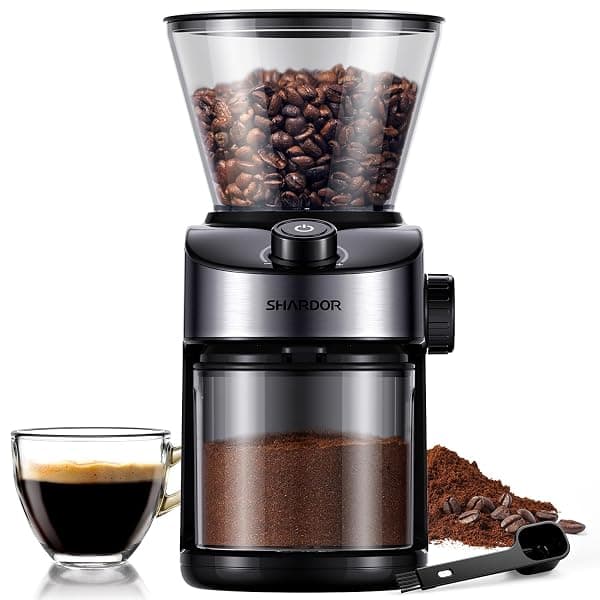
A blade grinder chops the beans for as long as you hold the button, while a burr grinder only lets them through once they are small enough to pass between the burrs. You can taste the difference. A blade leaves fine dust and larger chunks mixed together, and the two brew at different speeds: the dust gives up its flavour quickly and can taste bitter, while the chunks stay sour and thin. A burr grinder turns out pieces much closer in size, and you set that size with a dial instead of guessing with a stopwatch. The KYG listing names 304 stainless steel blades, so it is the blade type. The SHARDOR is listed as an electric burr grinder with 25 grind settings. Some listings name neither blades nor burrs, so if the type matters to you, ask the seller before you buy.
02Which grind size does your brew method need?
Buy for the finest grind you will need, because espresso asks the most of a grinder and a cafetière asks the least. A cafetière takes a coarse grind, roughly like sea salt, so the mesh can hold the grounds back. Filter machines and pour-over sit at medium. An AeroPress works anywhere from fine to medium, and a stovetop moka pot wants a fine grind, slightly coarser than espresso. Espresso needs a fine grind you can adjust in small steps, since a slight change alters how fast the shot runs through. A blade grinder gets close enough for a cafetière or filter machine if you grind in short pulses and shake it between them. For espresso it falls short: the dust clogs the basket while the bigger pieces let water rush past. If an espresso machine is on your list, choose a grinder whose listing names espresso, such as the Woobroo hand grinder, and check that it uses burrs.
03Should you choose a manual or an electric grinder?
Choose electric if you brew several cups a day or grind for a household, and consider a hand grinder if you make one or two cups and would like it quiet or portable. Turning the handle for a single mug's worth of beans takes a minute or more. That is pleasant at the weekend and less so before work. A hand grinder needs no socket, so it can go to the office or away on holiday, and the Woobroo listing names home, office and travel. Most hand grinders use burrs, though the Woobroo listing doesn't say, so check that point on any hand grinder you look at. An electric burr grinder such as the SHARDOR does the work while the kettle boils. Blade grinders are the fastest of all, getting through a small bowl of beans in a few short bursts.
04How noisy is each type of coffee grinder?
Most electric grinders are loud, but a blade grinder is loud for a few seconds while a burr grinder usually runs for longer at a lower pitch. A hand grinder makes only a soft crunching sound. If you are up before the rest of the house, or live in a flat with thin walls, that can decide the matter. Noise figures appear on only a few listings. The KYG listing quotes 45dB and calls it low noise, which is the seller's figure for that model, so don't assume every blade grinder will match it. With any electric grinder, standing it on a folded tea towel cuts some of the rattle through the worktop.
05Which grinder is easier to keep clean?
A blade grinder is the simpler one to clean: unplug it, tip out the grounds and wipe the bowl with a dry cloth or a small brush. Never hold the motor base under the tap. A burr grinder needs its burrs brushed out every week or two, since coffee oils and fine grounds build up and go stale, which you will taste in the cup. Many burr grinders let you lift out the top burr to reach them, but follow the manual for your model. Spices are the other thing to plan for. Cumin, chilli and cardamom leave oils behind that carry into the next brew, so either wipe the bowl very thoroughly or keep a second small grinder just for spices. Grinders sold as coffee grinders and spice mills in one are normally the blade type, and the KYG and Aigostar listings both name spices.
Our top picks
Best electric burr grinder for daily filter coffeeSHARDOR Coffee Grinder Electric Burr with
With 25 adjustable grind settings, SHARDOR's burr grinder has room to go coarse for a cafetière or medium for a filter machine, and you can nudge it a step when a cup tastes off. It is electric, so you are not turning a handle every morning. A sensible choice if you brew most days and want the even grind burrs give.
Best hand grinder for quiet mornings and travelManual Coffee Grinder
Woobroo lists 40 grind settings, adjusted from outside the body, and names espresso, AeroPress, pour-over, moka pots and French press among its uses. With no motor it stays quiet enough for an early start, and it packs into a bag for the office or a trip. Worth a look for anyone who makes one or two cups at a time.
Best blade grinder for cafetière coffee and spicesKYG Electric Coffee Grinder 300 W
KYG pairs 304 stainless steel blades with a 300W motor, a 70g bowl and a safety lock, and the listing names nuts and spices as well as coffee. Short pulses give a grind that works for a cafetière or filter machine. Espresso is beyond it, so keep it for coarser brews or as the spice grinder beside a burr model.
Best small grinder for coffee and spices in oneAigostar 200W Electric Coffee Grinder &
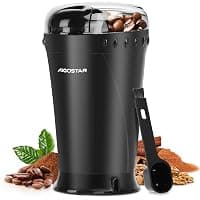
Aigostar sells this as an electric coffee grinder and spice mill, with a 200W motor and a 60g capacity. That size suits one or two cafetière brews, or a batch of whole spices for a curry. If it ends up as your spice grinder, you will not have to clean the coffee grinder so carefully.
Frequently asked
Do I need a coffee grinder if my coffee machine has one built in?
Not for the machine itself, because a bean-to-cup machine grinds fresh for every drink. A separate grinder earns its place when you also brew in a cafetière or by pour-over, since the built-in grinder is set up for espresso and grinds straight into the brewing unit, so you can't use it to fill a cafetière.
How much coffee should I grind for one mug?
A common starting point is about 60g of coffee per litre of water, which works out at roughly 15g for a 250ml mug. Weigh the beans for the first few days until you know how full to fill the grinder, then adjust to taste: more coffee for a stronger cup, less for a lighter one.
How long does ground coffee stay fresh?
Ground coffee goes stale much faster than whole beans, because grinding exposes far more of the coffee to air. Grind only what you need for each brew where you can. Keep beans in an airtight container somewhere cool and dark, and out of the fridge, where they can pick up damp and smells.
Can I grind coffee beans in a blender or food processor?
You can in a pinch, since a blender works much like a blade grinder with a bigger bowl. The grind comes out even less consistent, so it is only worth doing for a cafetière. Pulse rather than run it, and clean the jug well afterwards, because coffee oils cling to plastic.
Is a conical or flat burr grinder better at home?
Both grind evenly enough for home brewing, and the difference is smaller than the gap between any burr grinder and a blade one. Conical burrs are common in home and hand grinders, while flat burrs turn up more often in café grinders. Pick on grind settings and ease of use rather than burr shape.