
These two appliances look similar on the worktop but do fundamentally different jobs. A food processor uses interchangeable discs and blades to chop, slice, shred and knead, while a blender pulverises ingredients into smooth liquids. For most UK home cooks, the choice comes down to one question: do you prep solid ingredients more often than you make drinks or soups?

What to look for
01Bowl capacity and kitchen footprint
UK kitchens average around 600mm of usable worktop depth, so footprint matters as much as capacity. Mini choppers with 500ml to 600ml bowls, such as the LINKChef 500ml and Sensio Home 600ml models, tuck into a cupboard easily and suit one or two people. Step up to 1.4L to 2L and you can handle a full batch of pastry or enough salad for four. The Kenwood FP120 at 1.4L and the Russell Hobbs Desire at 1.5L usable capacity sit in a practical middle ground. If you are buying a blender instead, check the jug height against your overhead cupboards before ordering, as tall jugs can exceed 45cm and will not fit under standard wall units.
02Motor wattage and what it means on UK mains
All UK appliances run on 240V mains, so wattage directly reflects how hard the motor works. Budget mini choppers typically run at 260W to 300W, which is adequate for onions, garlic, nuts and soft vegetables. The LINKChef 260W and Sensio Home 300W fall here. Move to 400W to 500W, as with the Kenwood FP120 at 400W and the IMURZ at 500W, and you gain enough torque for raw meat and harder root vegetables. The Russell Hobbs Desire at 600W handles short bursts of bread dough. The Braun MultiQuick 7 hand blender sits at 1,000W, which is appropriate for blending hot soups directly in the pan but is unnecessary for chopping tasks a processor handles more precisely.
03Blade and disc systems
Food processors win on versatility through interchangeable attachments. A standard chopping blade handles most tasks, but shredding and slicing discs let you prep coleslaw or gratin potatoes in seconds. The Kenwood FP120 includes a chopping blade, emulsifying blade and shredder disc. Bi-level blade designs, found on the LINKChef 500ml and IMURZ 2L models, claim more even chopping by cutting at two heights simultaneously. Blenders, including the Braun MultiQuick 7 with its ActiveBlade system, use a fixed blade optimised for liquid vortex action. That design is excellent for smoothies and soups but struggles with dry or chunky solids, which can bounce above the blade rather than being drawn into it.
04Hard-water areas and cleaning
If you live in a hard-water area, such as London, the South East or the Midlands, limescale builds up quickly on plastic bowls and inside blender jugs. Stainless steel bowls, as found on the LINKChef 1.5L and IMURZ 2L, resist staining and are easier to descale with a diluted white-vinegar rinse. Plastic bowls on the Kenwood FP120 and Russell Hobbs Desire are dishwasher-safe, which helps, but check the manufacturer's guidance before putting blades in the dishwasher as repeated cycles can dull stainless steel edges. Blender jugs with narrow bases are notoriously awkward to clean by hand; a processor bowl with a wide opening is generally simpler to wipe out between tasks.
05When a blender beats a food processor
A blender is the better tool when your priority is smooth, lump-free results: smoothies, protein shakes, puréed soups, hollandaise or mayonnaise. The Braun MultiQuick 7 hand blender with its Splash Control design lets you blend directly in a saucepan or deep jug, which avoids transferring hot liquid. That is a genuine safety and convenience advantage over pouring scalding soup into a processor bowl. Hand blenders also take up almost no storage space. The trade-off is that they cannot slice, shred or knead, and they struggle with anything that needs a precise chop rather than a purée. If you regularly make hummus, pesto or nut butter, a food processor gives you more control over final texture.
Our top picks
Best for small households chopping daily vegLINKChef Food Processor

The LINKChef 1.5L stainless steel bowl is a practical size for one to three people, and the three-layer blade design cuts at multiple heights to reduce the uneven chunks that single-blade choppers can leave. Dual-speed control lets you pulse garlic coarsely or run continuously for meat. The stainless steel bowl resists staining in hard-water areas and wipes clean quickly.
Best compact chopper for small kitchensLINKChef Food Processor
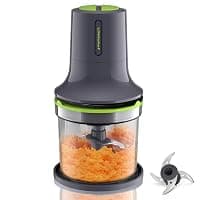
At 260W with a 500ml bowl and four bi-level blades, this LINKChef mini chopper is sized for a single portion of onions, garlic or baby food without taking up meaningful worktop space. The integrated power-cord storage keeps the cable tidy in a cramped kitchen drawer. Two speed settings cover both a rough chop and a finer mince.
Best mid-range processor from a trusted UK brandKenwood Compact Food Processor
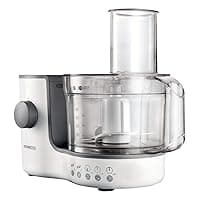
Kenwood's FP120 runs at 400W on UK 240V mains and includes a chopping blade, emulsifying blade and shredder disc in the box, making it one of the most attachment-complete options at this price tier. The 1.4L bowl suits a family of three to four, and the blender attachment extends its range to soups and smoothies without buying a separate appliance.
Best for batch cooking and doughRussell Hobbs Desire Electric Food Processor
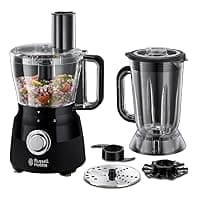
The Russell Hobbs Desire delivers 600W through a 1.5L usable-capacity bowl, giving it enough torque for short kneading bursts and larger vegetable batches. At 600W it sits at the upper end of compact processors on UK mains, which translates to faster work on dense ingredients such as raw carrots or minced meat without the motor straining.
Best blender alternative for soups and smoothiesBraun MultiQuick 7 MQ7045 Hand Blender

The Braun MultiQuick 7 runs at 1,000W and uses an ActiveBlade system that moves up and down during blending to draw ingredients into the blade more consistently. The EasyClick Plus attachment system and Splash Control design make it practical for blending hot soups directly in the pan, which is the key use case where a food processor cannot compete.
Best budget pick for occasional useSensio Home Mini Food Chopper Processor
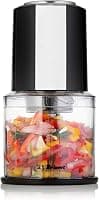
The Sensio Home mini chopper runs at 300W with four stainless steel blades in a 600ml bowl. That capacity handles a medium onion, a handful of nuts or a portion of baby food in one go. At 300W it is not designed for raw meat or hard root vegetables, but for light, occasional prep work it offers a compact and affordable entry point.
Best value for a larger stainless steel bowlMini Chopper Electric Food Processor with
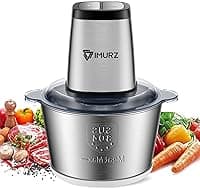
The IMURZ mini chopper pairs a 500W motor with a 2L stainless steel bowl, which is unusually generous at this price point and suits households that prep larger quantities in one session. Four bi-level blades at two heights improve chopping consistency, and the stainless steel construction is more durable than plastic bowls in hard-water areas.
Best for reliability and brand supportBosch MultiTalent 3 Food Processor
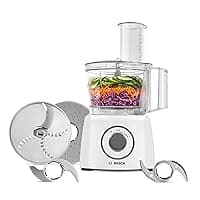
The Bosch MultiTalent 3 MCM3100WGB is a compact processor from a brand with strong UK after-sales support and widely available spare parts. Its compact footprint suits a 600mm worktop depth, and Bosch's build quality on the bowl and lid mechanism is noticeably more robust than budget alternatives at a similar price tier.
Frequently asked
What is the difference between a food processor and a blender?
A food processor uses a wide, shallow bowl with interchangeable blades and discs to chop, slice, shred, grate and sometimes knead. A blender uses a tall, narrow jug with a fixed blade spinning at high speed to create a liquid vortex, which produces smooth purées, soups and drinks. Food processors give you more control over texture and handle solid ingredients better. Blenders are faster at producing completely smooth results from wet ingredients. If you cook a wide variety of dishes, a food processor is generally the more versatile choice.
Can a food processor replace a blender?
Partly, but not entirely. Most food processors include a blending or emulsifying blade that handles smoothies, sauces and soups reasonably well, and the Kenwood FP120 comes with an emulsifying blade for exactly this purpose. However, a food processor bowl is wider and shallower than a blender jug, so it is less efficient at creating the tight liquid vortex needed for very smooth results. For occasional blending alongside regular chopping and slicing, a food processor covers both jobs adequately. For daily smoothies or very smooth soups, a dedicated blender or hand blender such as the Braun MultiQuick 7 will give better results.
What wattage food processor do I need for the UK?
On UK 240V mains, 260W to 300W is sufficient for soft vegetables, garlic, onions, nuts and baby food. Step up to 400W to 500W for raw meat, harder root vegetables and larger batches. 600W gives you enough torque for occasional dough kneading. You rarely need more than 600W in a compact home food processor. Higher wattage does not automatically mean better chopping quality; blade design and bowl shape matter equally.
Is a mini food chopper worth buying instead of a full-size food processor?
A mini chopper with a 500ml to 600ml bowl is worth buying if you cook for one or two people and mainly need to chop onions, garlic, herbs or nuts quickly. It takes up less cupboard space, costs less and is easier to clean. The trade-off is that you cannot slice or shred with a mini chopper, and the small bowl means you have to work in batches for larger quantities. If you regularly cook for four or more, or want slicing and shredding discs, a full-size processor with a 1.4L to 2L bowl is a better long-term investment.
Are food processors easy to clean?
Most food processor bowls and blades are dishwasher-safe, but check the manufacturer's guidance first, as repeated dishwasher cycles can dull blade edges over time. Stainless steel bowls, such as those on the LINKChef 1.5L and IMURZ 2L, are easier to wipe clean and resist staining better than plastic, which is particularly useful in hard-water areas where limescale deposits build up quickly. Wide-mouthed bowls are simpler to clean by hand than narrow blender jugs. Disassemble the blade and bowl immediately after use so food residue does not dry and harden.