
Boiling a full 1.7L kettle on a typical UK electricity tariff costs around 1p per cycle, but fill habits, limescale build-up, and wattage all shift that figure meaningfully over a year. This guide breaks down the real running costs of eight popular kettles, from a £14.99 Daewoo to a £27.00 Cosori, so you can pick the one that suits your kitchen and your budget.
What to look for
01Wattage and energy per boil
Every kettle on this list runs at either 3kW or 1kW on the UK 240V mains supply. A 3kW model (Russell Hobbs Textures, both Honeycomb variants, Cosori Glass, Cosori Stainless) reaches boiling faster, which matters because the kettle draws power for less time. A 1kW travel kettle (Russell Hobbs 23840) takes roughly three times as long to boil the same volume, consuming the same energy overall. The key insight: wattage alone does not change the energy cost of a single full boil. What changes your bill is how much water you actually boil. Filling a 1.7L kettle for one cup wastes roughly 1.2L of heated water and the energy to heat it. Over 1,000 boils a year, that discipline saves you roughly £8.50 annually, more than the price gap between the cheapest and mid-range models here.
02Limescale and efficiency loss
If you live in a hard-water area (roughly 60% of England, including London, the South East, and the Midlands), limescale deposits on the heating element act as insulation. Research from the Energy Saving Trust suggests just 1mm of scale can increase energy consumption by around 7%. Over a year of twice-daily boiling, that adds up. All eight kettles here include a removable, washable anti-scale filter to protect the spout, but the filter does not descale the element itself. Descaling every four to six weeks with a proprietary solution or diluted white vinegar is the single most effective way to keep running costs down. The Cosori Stainless Steel (B0GN41PZLS) and Cosori Glass (B0F63CJ9WK) both feature stainless steel or glass water-contact surfaces, which accumulate scale more visibly than opaque plastic, making it easier to spot when descaling is overdue.
03Capacity and fill discipline
The 1. 7L capacity shared by most models here is the UK standard, sized to fit neatly on a 600mm worktop. The Russell Hobbs Travel Kettle (B07B96BQM6) holds just 0.85L, which is actually an advantage for solo households: you physically cannot overfill it by much. For a two-person household making four cups a day, a 1.7L kettle filled to the minimum line (around 500ml) is more economical than a travel kettle filled to its maximum. The dual-voltage feature on the travel model (100-240V) is irrelevant to UK running costs but useful if you take it abroad. For home use, focus on the minimum-fill marker and use it consistently. Water windows on the Russell Hobbs Travel Kettle and graduated markings on the Cosori Glass model make accurate filling easier, which directly reduces wasted energy.
04Purchase price versus lifetime cost
The cheapest kettle here, the Russell Hobbs Textures (B01A84QLG4) at £19. 99 (and a 90-day low of £8.00), costs less upfront than the Cosori Stainless at £27.00. But if a cheaper plastic kettle lasts two years and a stainless model lasts five, the annual cost of ownership shifts significantly. At roughly 730 boils a year and 1.2p per full boil, the energy cost is around £8.76 annually regardless of model, assuming identical fill habits. The real differentiator is build quality and descaling ease. Stainless and glass interiors resist staining and are easier to inspect, potentially extending service life. Factor in a £3 to £5 descaling product twice a year and the total cost of ownership for any model here sits between roughly £25 and £50 over three years, making the upfront price difference between the cheapest and most expensive option here relatively minor.
Our top picks
Best for low-maintenance running costs in a hard-water areaCosori Kettle
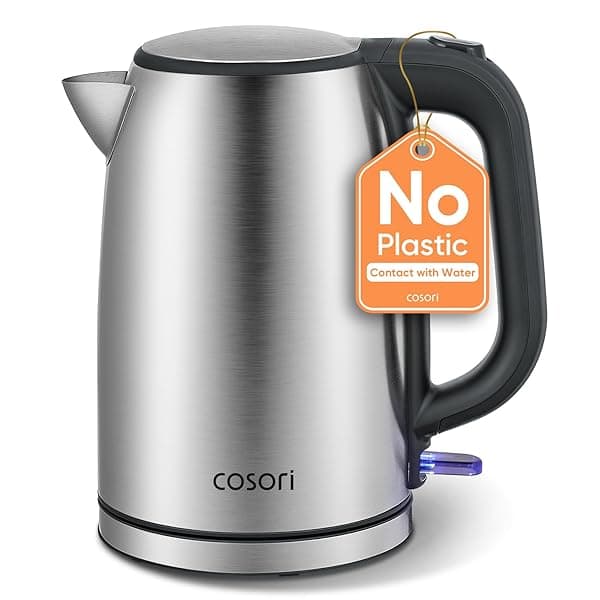
At £27.00 (its 90-day low, meaning it has not dropped further), the Cosori Brushed Stainless Steel runs at 3kW and has zero plastic in contact with the water. The stainless interior makes limescale deposits immediately visible, so you descale before efficiency drops rather than after.
Best budget pick for keeping upfront costs minimalRussell Hobbs Textures Electric 1.7L Cordless
The Russell Hobbs Textures is currently £19.99, but its 90-day low was £8.00, so it regularly drops sharply. At 3kW with a 1.7L capacity, the running cost per boil is identical to pricier models. The removable anti-scale filter and push-to-open lid are practical daily features.
Best for solo households and reducing wasted energyRussell Hobbs Electric 0.85L Travel Kettle
The Russell Hobbs Travel Kettle holds 0.85L and costs £14.99. Its smaller maximum capacity means you boil less water by default, which is the most effective way to cut kettle running costs. At 1000W it draws less peak power, useful if you are on a time-of-use tariff. Dual voltage (100-240V) adds value for frequent travellers.
Best mid-range kettle for everyday family useRussell Hobbs Honeycomb Electric 1.7L Cordless
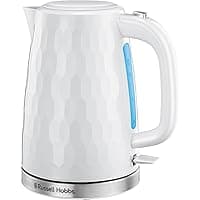
The Russell Hobbs Honeycomb White (B0833ML8W8) costs £23.00, down from a 90-day high of £23.99, with a 90-day low of £17.60. It runs at 3kW with a 1.7L capacity, a washable anti-scale filter, and a push-button lid that makes one-handed filling straightforward.
Frequently asked
How much does it cost to boil a kettle in the UK?
Boiling just 500ml costs roughly 0.35p. Over a year of four boils a day, the difference between always filling to the top and always filling to the minimum is approximately £8 to £10. The kettle model matters far less than your fill discipline and how often you descale the heating element.
Does a higher wattage kettle use more electricity?
Not per boil. A 3kW kettle boils water faster than a 1kW kettle, but it uses the same amount of energy to heat the same volume of water to 100°C. The physics are the same: energy equals power multiplied by time. A 3kW kettle takes one third of the time of a 1kW kettle, so the total energy consumed per boil is essentially equal.
How often should I descale my kettle in a hard-water area?
In hard-water areas such as London, the South East, and the East Midlands, descale every four to six weeks. In soft-water areas (Scotland, Wales, the North West), every two to three months is usually sufficient. Use a proprietary kettle descaler or a solution of one part white vinegar to one part water, fill to the halfway mark, boil, leave for 30 minutes, then rinse thoroughly. Regular descaling keeps the heating element efficient and can reduce energy use by up to 7% compared with a heavily scaled element.
Is a glass or stainless steel kettle cheaper to run than a plastic one?
The material of the body does not affect energy consumption. All 3kW kettles here cost the same to run per boil. The practical advantage of glass (Cosori B0F63CJ9WK) and stainless steel (Cosori B0GN41PZLS) is that limescale is visible on the interior surface, prompting more timely descaling. A scaled element on any kettle, plastic or otherwise, uses more energy. So indirectly, a material that encourages regular descaling can keep running costs marginally lower over time.
What is the cheapest kettle to buy and run long-term?
The Russell Hobbs Textures (B01A84QLG4) has a current price of £19.99 and a 90-day low of £8.00, making it the lowest-cost entry point when it is on offer. Running costs across all 3kW models here are virtually identical at around £8 to £9 per year based on four boils daily. The cheapest long-term option is whichever model you descale consistently and replace least often. A slightly pricier stainless kettle that lasts five years can cost less annually than a budget plastic model replaced every two years.