
A good stand mixer takes the hard work out of bread, cakes, and pastry for the whole family. The right bowl size matters most: a 6L or larger bowl lets you mix double batches without stopping, and on a UK 240V mains supply, motors rated at 1,300W will power through stiff dough without straining.
What to look for
01Bowl capacity and family batch sizes
For a family of four or more, a bowl of at least 5L is the practical minimum. A 6L or 6.2L bowl lets you make two loaves of bread dough or a double sponge cake in a single mix, which saves real time on a busy weekend. Most UK kitchen worktops are 60cm deep, so check the footprint before you buy — taller tilt-head models can also foul low-mounted wall cupboards. If you bake for a crowd regularly, the dual-bowl designs (4.5L plus 5L) give you flexibility to prep two different mixtures back to back without washing up in between. Stainless steel bowls are easier to clean and more durable than plastic, and they handle hot sugar work safely.
02Motor wattage and dough performance
On the UK 240V mains supply, a motor rated at 1,300W delivers noticeably more torque than the 600–800W motors common on budget machines. That extra power matters when you are mixing stiff bread dough or dense cookie batter. Lower-wattage motors can overheat and cut out mid-mix, which is frustrating and shortens the motor's life. Look for a machine with at least 10 speed settings so you can start slow to avoid flour clouds, then ramp up for whipping cream or egg whites. Planetary mixing action — where the attachment orbits the bowl rather than spinning in one spot — gives more thorough coverage and is worth prioritising over simpler gear-driven designs.
03Attachments and long-term value
Every stand mixer in this guide includes a dough hook, wire whisk, and flat beater as standard, which covers the vast majority of home baking tasks. Check that the attachments are dishwasher-safe, because hand-washing a dough hook after a bread session is tedious. Some brands use a universal hub that accepts pasta rollers, meat grinders, and other accessories sold separately — this can extend the machine's usefulness considerably. Budget models often use plastic gears internally, which can strip under heavy loads; metal gears are a sign of better build quality. At the £99–£110 price point you are buying a capable workhorse, not a heirloom appliance, so factor in the warranty length (look for at least one year) when comparing options.
04Price tracking and when to buy
Stand mixer prices on Amazon UK fluctuate more than you might expect. The Kitchen in the box 1,300W models, for example, have a 90-day low of £84.00 against a current price of £99.99 — a gap of nearly £16. Checking the 90-day price history before you buy is worthwhile, especially around bank holidays and mid-year sales events. The KitchenAid Professional has dropped from £757.98 to £523.84 within the same 90-day window, so patience pays off if you have your heart set on a premium machine. If you live in a hard-water area, limescale is less of a concern for mixers than for kettles, but it does affect any water-cooled motor cooling vents — keep them clear.
Our top picks
Best for large-batch baking on a budgetAucma Stand Mixer
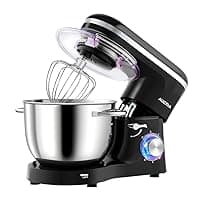
At £109.99 with a 6.2L stainless steel bowl, the Aucma is the largest-capacity option under £110 in this guide. The tilt-head design makes swapping attachments straightforward, and the bowl is big enough for a double batch of bread dough in one go.
Best for versatile two-bowl prepKitchen in the box Stand Mixer
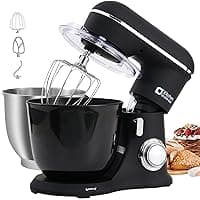
Currently at £99.99 — its 90-day low was £84.00, so it is worth watching for a dip — the Kitchen in the box 1,300W model is the most powerful machine in this price bracket. The dual-bowl setup (4.5L and 5L) is genuinely useful when you need to whip cream in one bowl while dough proves in the other. Ten speed settings and a 1,300W motor handle stiff bread dough without the motor straining.
Best 6L option if you want a splash of colourKitchen in the box Stand Mixer
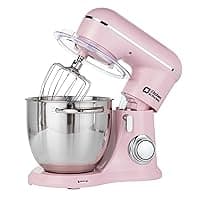
The Kitchen in the box 6L Pink model sits at £109.99, down from a 90-day high of £119.99, and pairs a 1,300W motor with a 6L bowl — the same capacity as many machines costing significantly more. Ten speeds, planetary mixing action, and the full trio of attachments make it a practical choice for families who bake bread and cakes regularly. The pink finish suits smaller UK kitchens where the mixer lives on the worktop permanently.
Best for serious bakers who want a long-term machineKitchenAid Professional 325 W Stand Mixer
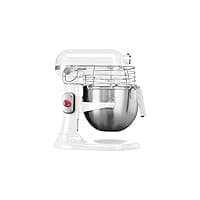
The KitchenAid Professional 5KSM7990X carries a 6.9L bowl and 325W direct-drive motor — KitchenAid's wattage rating reflects continuous output rather than peak draw, so real-world torque is higher than the number suggests. Its 90-day low of £523.84 is the time to buy if your budget stretches. Planetary mixing action, a stainless steel wire guard, and a universal accessory hub make this a machine you will use for decades rather than years.
Frequently asked
What size stand mixer do I need for a family?
For a family of four, a 5L bowl is the practical minimum. A 6L or 6.2L bowl is better if you regularly make bread, as a standard two-loaf batch of dough weighs around 1.2kg and needs room to move. Smaller 4.5L bowls are fine for cakes and biscuits but can overflow when mixing large quantities of stiff dough. If you bake for parties or batch-cook, go for 6L or above.
Is 1300W enough for bread dough in a stand mixer?
Yes, 1,300W is more than adequate for home bread baking on a UK 240V supply. Most domestic bread recipes call for dough that is kneaded for 8 to 10 minutes, and a 1,300W motor handles this without overheating. Budget mixers rated at 600W to 800W can struggle with stiff wholemeal or enriched doughs and may cut out on a thermal overload. If you bake dense rye or high-hydration sourdough regularly, the extra wattage is worth having.
Are budget stand mixers worth buying, or should I save up for a KitchenAid?
Budget stand mixers in the £85 to £110 range are genuinely capable for everyday family baking. They handle cakes, biscuits, and standard bread doughs well. The trade-off is build quality over time: plastic internal gears and lighter motors may not last as long under heavy weekly use. A KitchenAid Professional, when bought at its 90-day low of around £523.84, offers metal gears, a larger 6.9L bowl, and a universal accessory hub that adds pasta and meat-grinding attachments. Buy budget if you bake occasionally; invest in KitchenAid if the mixer will be used several times a week for years.
What attachments should a stand mixer come with as standard?
At minimum, look for three attachments: 1. A dough hook for bread and pizza dough. 2. A flat beater (also called a paddle) for cake batter, biscuit dough, and mashed potato. 3. A wire whisk for whipping cream, egg whites, and light sponge mixtures. All the mixers in this guide include all three. Dishwasher-safe attachments are a practical bonus, especially for the dough hook, which is awkward to clean by hand after a bread session.