
Choosing between a planetary and spiral stand mixer comes down to what you bake most. Planetary mixers handle at least 6 tasks in one machine, from meringues to bread dough, and every model in this guide runs on the UK's 230V mains supply. Spiral mixers suit dedicated bread bakers, but for most UK kitchens, planetary wins on versatility.

What to look for
01Mixing action: planetary versus spiral
A planetary mixer moves its attachment in an orbit around a fixed bowl, covering the full interior on every pass. This makes it genuinely versatile: the same machine whisks egg whites, creams butter, and kneads dough without you swapping the bowl. A spiral mixer, by contrast, rotates both the hook and the bowl in opposite directions, concentrating force at the base where dough sits. That focused action develops gluten faster and keeps the dough cooler, which professional bakers value for sourdough and enriched loaves. For home use, though, most people bake cakes, biscuits, and the occasional loaf, so a planetary machine covers the full range. Every stand mixer in this guide uses a planetary action, which is why they all ship with a dough hook, a flat beater, and a balloon whisk as standard. If you bake bread exclusively and in large batches, a dedicated spiral machine is worth considering, but the budget and counter-space cost is considerably higher.
02Bowl capacity and UK kitchen sizing
Bowl size determines how much you can make in a single batch. A 3.5 L bowl, like the one on the Kenwood Chefette, suits a standard 12-cupcake mix or a 900 g loaf. Step up to 4.5 L or 5 L and you can double most recipes, which matters if you bake for a family or freeze ahead. The Aucma and Kitchen in the Box 6 L models handle up to 1.5 kg of bread dough in one go. Before you buy, measure your worktop clearance: most stand mixers in this range stand between 30 cm and 38 cm tall, and the tilt-head design means you need at least 50 cm of overhead space to lift the head fully. UK kitchens with standard 600 mm-deep worktops can accommodate any of these machines, but check the footprint too, as a 6 L bowl adds roughly 5 cm to the overall width compared with a 3.5 L model.
03Motor wattage and what it means for dough
Wattage tells you how much power the motor draws, not how much it delivers to the dough, but it is still a useful proxy for capability. The Judge 2-in-1 draws 300 W, which is adequate for light batters and whipped cream but will labour through stiff bread dough. The Kenwood Chefette runs at 650 W, a comfortable middle ground for most home baking. The Aucma reaches 1,400 W and the YASHE 1,500 W, both of which handle dense, enriched doughs with less risk of the motor overheating mid-knead. On the UK's 230V supply, all of these sit well within the 13A limit of a standard BS 1363 plug, so no adaptor or dedicated circuit is needed. If you bake stiff rye or wholemeal doughs regularly, aim for at least 1,000 W. For cakes and meringues, 650 W is perfectly sufficient.
04Speed settings and control
More speed settings give you finer control, but only if they are evenly spaced. A machine with 10 distinct speeds lets you start a flour mix on speed 1 to avoid a dust cloud, then ramp up gradually without the motor lurching. The Vospeed offers 8 speeds, the Kitchen in the Box 6 L model offers 10, and the YASHE provides 10 plus a pulse function. Pulse is particularly useful for folding in chocolate chips or nuts at the end of a mix without over-working the batter. The Kenwood Chefette uses a variable dial with a pulse button, which gives smooth, stepless control rather than fixed increments. For most bakers, 6 to 8 speeds is plenty; 10 speeds becomes worthwhile if you regularly make delicate preparations like Italian meringue or choux pastry, where precise speed transitions matter.
05Attachments, accessories, and dishwasher safety
Every planetary stand mixer in this guide includes a dough hook, a flat beater, and a balloon whisk as standard. The difference lies in what else is included and whether the parts are dishwasher safe. The YASHE explicitly states its accessories are dishwasher safe, which saves time after a heavy baking session. The Kitchen in the Box dual-bowl model ships with two bowls of different sizes, giving you the option to prep a filling in one bowl while the main mix runs in the other. The Kenwood Chefette, as a branded machine, has a wider ecosystem of optional attachments available separately, including a mincer and a pasta roller, though these cost extra. Splash guards are included with the Vospeed and YASHE, which is a practical addition when you are adding liquid to a running mixer. Check that the bowl has a secure locking mechanism: a bowl that creeps during kneading is a safety and mess issue.
Our top picks
Best for everyday baking in a smaller kitchenKenwood Chefette Stand Mixer HMP54.000SI

The Kenwood Chefette's 650 W motor and 3.5 L stainless steel bowl hit the sweet spot for a household that bakes cakes and biscuits weekly without needing industrial capacity. The variable-speed dial with pulse gives stepless control that fixed-increment machines cannot match. Kenwood's established UK presence means spare parts and optional attachments are genuinely available, and the compact footprint fits a 600 mm worktop without dominating it.
Best for large-batch bread bakingAucma Stand Mixer
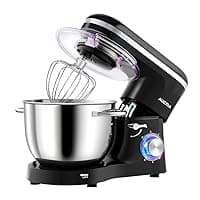
A 1,400 W motor paired with a 6.2 L bowl means the Aucma can work through a double batch of wholemeal dough without straining. At that capacity you can knead enough for two 900 g loaves in a single run, which makes it practical for weekly bread bakers. The tilt-head design gives clear access to the bowl for scraping down, and the machine runs on a standard UK 13A plug with no modifications needed.
Best for bakers who need two bowls at onceKitchen in the box Stand Mixer
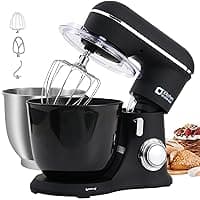
The Kitchen in the Box dual-bowl setup ships with a 4.5 L and a 5 L bowl, letting you prepare a cake batter in one and a buttercream filling in the other without washing up between stages. That practical detail saves real time during multi-component bakes. The machine is aimed squarely at home bakers who follow layered-cake recipes and resent the bottleneck of a single bowl.
Best for high-power mixing with dishwasher-safe accessoriesYASHE Stand Mixer

The YASHE's 1,500 W motor is the highest-wattage machine in this group, and its dual 4.5 L plus 5 L bowl configuration mirrors the Kitchen in the Box approach while adding confirmed dishwasher-safe accessories. Ten speeds plus a pulse function give precise control from a slow fold to a full whip. The tilt-head mechanism keeps the bowl accessible throughout a long knead.
Frequently asked
What is the difference between a planetary and a spiral stand mixer?
A planetary mixer moves its attachment in an orbit around a stationary bowl, so the whisk or hook covers the full bowl on every rotation. This suits a wide range of tasks: cakes, meringues, pasta dough, and bread. A spiral mixer rotates both the hook and the bowl in opposite directions, concentrating force at the base. This develops gluten more efficiently and keeps dough cooler, which professional bread bakers prefer. For most UK home kitchens, a planetary machine is the more practical choice because it handles the full range of baking tasks with one set of attachments.
How much wattage do I need in a stand mixer for bread dough?
For occasional bread baking alongside cakes and biscuits, 650 W is workable. For regular bread baking, particularly with wholemeal, rye, or enriched doughs, aim for at least 1,000 W. Stiff doughs create significant resistance, and a lower-wattage motor will run hot and may cut out on a thermal overload switch. The Aucma at 1,400 W and the YASHE at 1,500 W are the strongest options in this group for dedicated bread bakers. All models here run on the UK's standard 230V supply via a BS 1363 plug.
What bowl size stand mixer do I need for a UK home kitchen?
A 3.5 L bowl handles a standard 12-cupcake mix or a single 900 g loaf. A 4.5 L to 5 L bowl lets you double most recipes, which is useful if you bake for four or more people or like to freeze portions. A 6 L bowl is worth considering only if you regularly make large batches of bread or bake for events. Check your worktop height before buying: tilt-head models need roughly 50 cm of overhead clearance to open fully, and a 6 L machine will be noticeably wider than a 3.5 L one.
Are stand mixer attachments dishwasher safe?
It depends on the model. The YASHE explicitly states its dough hook, beater, and whisk are dishwasher safe. For other brands in this group, the safest approach is to hand-wash stainless steel attachments in warm soapy water, as repeated dishwasher cycles can dull the finish and, on some alloys, cause surface pitting over time. Bowls with a non-stick coating should always be hand-washed. Check the manual for your specific model before putting anything in the dishwasher.
Can I use a stand mixer in a hard-water area without problems?
The mixer itself is unaffected by water hardness. The issue arises indirectly: if you live in a hard-water area and use tap water in bread doughs, the higher mineral content can slightly tighten gluten, meaning your dough may feel stiffer than a recipe developed in a soft-water region suggests. This is a baking chemistry point rather than a machine issue. The motor, bowl, and attachments will perform identically regardless of your local water supply.