
A decent 4-slice toaster costs under £50 in the UK, and the gap in everyday performance between a budget model and a pricier one is smaller than you might expect. What actually changes is wattage, slot width and which convenience functions are included, such as frozen bread, reheat or anti-jam settings. This guide compares 8 toasters on those durable specs to find the right one for your kitchen counter, your bread drawer and your morning routine.
What to look for
01Wattage and how quickly it toasts
On the UK 240V mains supply, a 2-slice toaster typically draws around 850W, as on the Russell Hobbs 24080, while 4-slice models in this guide run 1,400W to 1,500W: the Quest 4-slice draws 1,400W, and the Russell Hobbs Honeycomb and Futura ranges draw 1,500W. Higher wattage generally means a faster toasting cycle at the same browning setting, which matters if you are making toast for a family every morning. If you only toast occasionally, wattage matters less than slot width and browning consistency. Running a kettle and a 4-slice toaster on the same UK ring-main circuit at once is rarely a problem, but it is worth avoiding on an older or shared socket.
02Slot width and what fits inside
Standard UK bread slices are roughly 12cm wide, but thick-cut loaves, sourdough doorsteps, crumpets, and bagels all need wider slots. Look for slots described as extra wide, typically 35mm to 40mm across; both Russell Hobbs Honeycomb 4-slice models in this guide are built with extra-wide slots, and the Breville Curve pairs wide slots with a high-lift lever. A high-lift lever is worth having regardless of slot width: it lets you retrieve small items like English muffins or teacakes without burning your fingers, which matters more than it sounds at 7am. Depth matters too, a slot that is wide but shallow will still struggle with a tall bagel half or a thick artisan crust, so check both dimensions rather than width alone.
03Browning levels and consistency
Six browning levels is the standard across almost every model here, ranging from a light warm-through to a deep, dark toast. What varies is how evenly the heat is distributed across the full length of the slot. Russell Hobbs markets its Perfect Toast Technology on the 24080 specifically to address uneven browning, a common shortfall on cheaper elements. On a 4-slice toaster, independent slot control matters more than even heating alone: the Russell Hobbs Honeycomb 26073 offers independent and extra-wide slots, so you can run two slots at a different setting without wasting energy toasting an empty pair. Check the browning dial itself too, a numbered 1-6 dial is easier to repeat a setting on than an unmarked slider.
04Frozen, reheat and anti-jam functions
A handful of extra buttons make a real difference to everyday use, not just spec sheets. A frozen setting extends the cycle to toast bread straight from the freezer without burning the outside, which the Russell Hobbs 24080 includes as a dedicated Frozen and Cancel function, and the Russell Hobbs Honeycomb 26073 extends further with Frozen, Cancel and Reheat. Reheat warms toast that has gone cold without darkening it further, useful if you make a batch and it sits for a few minutes. An anti-jam function, included on the PIFCO 4-slice, is designed to stop bread getting stuck against the element, a genuine safety consideration as well as a convenience one. None of these functions affect wattage meaningfully, so they are worth prioritising over chasing slightly lower wattage.
05Cleaning and kitchen fit
A removable crumb tray is not a luxury feature: it is the difference between a toaster you clean weekly and one that smells of burning crumbs every morning. All the models here include one. Footprint matters too, particularly in a UK galley kitchen where worktop space is tight; a 4-slice toaster typically measures around 30cm to 35cm long and 15cm to 18cm wide, so measure your available worktop before buying. Stainless steel finishes, such as the Russell Hobbs Futura, show fingerprints more readily than a matte or textured finish, which is worth considering if you have young children. The Russell Hobbs Honeycomb range uses a textured high-gloss finish that hides marks reasonably well.
Our top picks
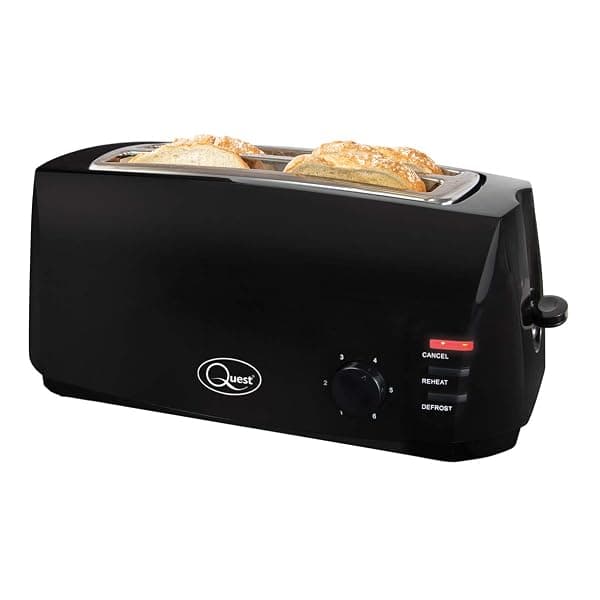
Best budget 4-sliceQuest 4 Slice Toaster with 6
The Quest 4 Slice runs at 1,400W with 6 browning settings, the lowest wattage of the 4-slice models in this guide alongside a straightforward control layout. It keeps the essentials, wide slots and even six-level browning, without independent slot control or extra functions, which suits a household that just wants consistent everyday toast without paying for features it won't use.
Best wide-slot for crumpets and bagelsRussell Hobbs Honeycomb 4 Slice Toaster
This Russell Hobbs Honeycomb 4 Slice is built with extra-wide slots and runs at 1,500W, aimed squarely at households that toast crumpets, bagels or thick-cut bread regularly rather than standard sliced loaves. The wider slot geometry means less squashing against the heating elements than a standard-width 4-slice model, which matters if artisan or home-baked bread is a regular feature of your kitchen.
Best stainless-steel finishRussell Hobbs 18790 Futura 4-Slice Toaster
The Russell Hobbs 18790 Futura is a 1,500W 4-slice toaster in a stainless steel silver finish, a straightforward metal-bodied alternative to the plastic-bodied models in this guide for kitchens with matching stainless appliances. It keeps to the core 4-slice, 1,500W spec without extra functions, so it suits buyers who prioritise finish and durability over programmable extras, and who would rather wipe down brushed metal than a painted or textured plastic body.
Best for retrieving small itemsBreville Curve 4 Slice Toaster with
![Breville Curve 4 Slice Toaster with High Lift & Wide Slots | Black & Chrome [VTT786] — Toasters deal](/_next/image?url=https%3A%2F%2Fm.media-amazon.com%2Fimages%2FI%2F71ueTVuGa9L._SL200_.jpg&w=256&q=75)
The Breville Curve pairs wide slots with a high-lift lever across 4 slices, designed specifically to make small items, English muffins, teacakes, thin bagel halves, easy to lift clear of the slot without burning your fingers. The Black and Chrome finish is a distinct look from the Russell Hobbs Honeycomb range, useful if you want a toaster that pairs with chrome-finish kitchen fittings.
Best for mixed browning preferences in one householdRussell Hobbs Honeycomb 4 Slice Toaster
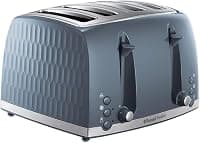
The Russell Hobbs Honeycomb 26073 combines independent slot control with extra-wide slots, a high-lift lever and a Frozen, Cancel and Reheat function, all at 1,500W. Independent control means one side of the toaster can run darker while the other runs lighter in the same cycle, useful for a household where preferences differ. The grey textured high-gloss finish also hides fingerprints better than plain stainless steel.
Frequently asked
What wattage toaster do I need for a UK home?
For a 2-slice toaster on the UK 240V mains supply, around 850W is standard and perfectly adequate for daily use, as on the Russell Hobbs 24080. A 4-slice toaster typically runs 1,400W to 1,500W in this guide. Higher wattage shortens the toasting cycle, which matters if you are making toast for a family every morning. There is no need to worry about overloading a standard UK ring-main circuit for a toaster used on its own, though running a 3kW kettle and a 1,500W toaster at the same time on the same socket is worth avoiding.
Are wide-slot toasters worth it for UK bread?
Yes, for most UK households. Standard supermarket sliced bread fits a regular slot, but thick-cut loaves, sourdough, crumpets, bagels, and teacakes all benefit from extra-wide slots, typically 35mm to 40mm across. Several models in this guide include extra-wide slots as standard. If you regularly buy artisan loaves from a bakery or make your own bread, wide slots are not optional, they are essential to avoid squashing the bread against the heating elements.
How do I clean a toaster properly?
Start by unplugging the toaster and leaving it to cool completely. Pull out the removable crumb tray, tap it over a bin, and wash it with warm soapy water. Turn the toaster upside down over the sink and gently shake to dislodge crumbs from inside the slots. Wipe the exterior with a damp cloth. Do not submerge the toaster in water or use abrasive cleaners on stainless steel finishes. Cleaning once a week prevents crumb build-up, which can cause burning smells and, in rare cases, a fire risk.
Is a 2-slice or 4-slice toaster better for a family?
For a household of three or more people, a 4-slice toaster saves time by halving the number of cycles needed at breakfast. A 4-slice model with independent slot controls, such as the Russell Hobbs Honeycomb 26073, lets you run two slots at different browning levels simultaneously, useful when adults want dark toast and children prefer lighter. For one or two people, a 2-slice model such as the Russell Hobbs Honeycomb 2-slice takes up less worktop space, which matters in a compact UK kitchen, and typically draws less power too.
Do toasters use a lot of electricity in the UK?
No, toasters are among the more efficient kitchen appliances because they run for only two to four minutes per cycle at a constant load. A 1,500W 4-slice toaster running for 3 minutes uses roughly 0.075 kWh. On the Ofgem price cap of 26.11p per kWh (1 Jul to 30 Sep 2026, Direct Debit, GB average), that works out to about 2p per cycle. Using it once a day for a month costs under £1, excluding the standing charge of 57.19p a day, which applies whether or not you use the toaster. Running cost is not a meaningful factor when choosing between models in this price range.