
Toaster wattage in the UK ranges from 850W to 1700W, and the difference affects both speed and running costs on your 240V mains supply. A higher-wattage model finishes a cycle in roughly half the time of a lower-wattage one, but each slice still draws similar energy overall. Knowing the numbers helps you pick the right toaster for your kitchen and your budget.
What to look for
01Wattage and how fast your toast actually appears
Wattage measures how quickly a toaster converts electricity into heat. An 850W model like the Russell Hobbs Honeycomb 2-Slice takes longer per cycle than a 1700W model such as the Russell Hobbs 24090, which finishes noticeably faster at the same browning setting. In practice, a 1700W toaster can cut cycle time by 30 to 40 per cent compared with an 850W unit. For a household toasting four slices every morning, that speed difference matters. However, because energy is power multiplied by time, a faster toaster does not necessarily use more electricity per slice. The total energy consumed per cycle is broadly similar across the wattage range. Where wattage genuinely matters is peak load: if your kitchen circuit is already running a kettle at 3kW, adding a 1700W toaster simultaneously is worth bearing in mind, though on a standard UK 13A socket this combination remains within safe limits.
02Running costs on a UK electricity tariff
At the current UK unit rate of roughly 24p per kWh, a single toast cycle costs a fraction of a penny regardless of wattage. An 850W toaster running for two minutes uses approximately 0.028 kWh, costing under 0.7p. A 1700W toaster completing the same job in around one minute uses roughly 0.028 kWh as well, so the cost is almost identical. Over a year of daily use, the difference between the cheapest and most powerful model in this range amounts to less than £1.00. This means wattage should not be your primary cost-saving concern. Slot size, browning consistency, and build quality will affect your satisfaction far more than the wattage figure on the box.
03Slot width and what fits in a UK kitchen
Most UK households keep a toaster on a 600mm worktop section, so footprint matters as much as wattage. Extra-wide slots, found on models like the Quest 4-Slice and the Russell Hobbs Honeycomb range, accommodate thick-cut bread, crumpets, and bagels without forcing them in. Slot width is typically 35mm to 40mm on standard models and up to 45mm on extra-wide versions. If you regularly toast sourdough or artisan loaves, prioritise slot width over wattage. A 4-slice toaster also takes up more counter space than a 2-slice, so measure your available worktop before buying. The Russell Hobbs Honeycomb 2-Slice at £23.00 is a compact option for smaller kitchens, while the 4-slice variants suit families who need throughput at breakfast.
04Hard-water areas and crumb tray maintenance
If you live in a hard-water area such as London, the South East, or the East Midlands, limescale is not a toaster concern the way it is for kettles. However, crumb build-up is a genuine fire risk and affects browning consistency over time. Every model in this range includes a removable crumb tray, which is the minimum you should expect. The PIFCO Essentials and Russell Hobbs Honeycomb models make a point of easy-clean trays. A blocked or dirty tray can cause uneven heat distribution, making your toaster behave as if it has lower wattage than its rating suggests. Clean the tray weekly for consistent results and to keep the heating elements performing as the manufacturer intended.
Our top picks
Best for small kitchens on a tight budgetRussell Hobbs Honeycomb 2 Slice Toaster
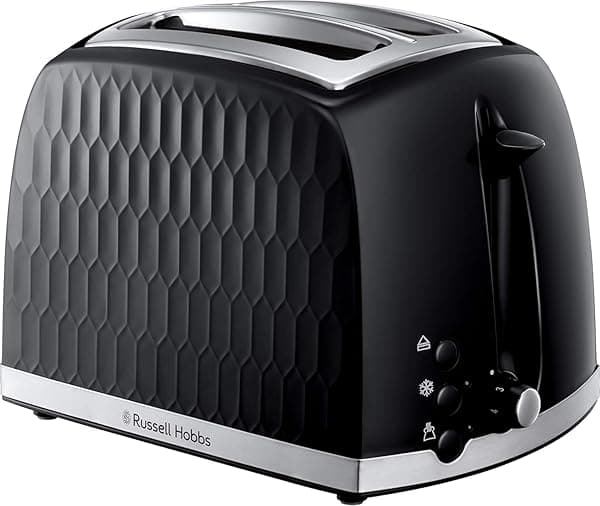
At £23.00 and rated 850W, the Russell Hobbs Honeycomb 2-Slice is the most affordable pick here and draws the least power on your 240V supply. Its extra-wide slots handle crumpets comfortably, and the high-lift feature helps you retrieve shorter slices safely. With 6 browning levels, a reheat function, and a removable crumb tray, it covers every daily need without taking up unnecessary worktop space.
Best 2-slice toaster for even browningRussell Hobbs 2 Slice Toaster with
The Russell Hobbs 24080 uses 850W and includes Perfect Toast Technology, which the brand says improves heat distribution across the slot for more consistent results. Currently at £24.00, it has dropped as low as £12.50 in the past 90 days, making it worth watching for a price dip. The lift-and-look feature lets you check browning mid-cycle without cancelling, which is genuinely useful for thick-cut or seeded loaves.
Best budget 4-slice toasterQuest 4 Slice Toaster Black
The Quest 4-Slice costs £24.99 and has hit a 90-day low of £19.00, so it represents strong value if you catch a price drop. Its extra-wide, extra-long slots are among the most accommodating in this range for crumpets and bagels.
Best 4-slice toaster for independent slot controlRussell Hobbs Honeycomb 4 Slice Toaster
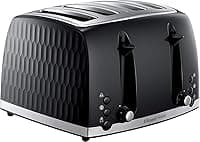
At 1500W and currently £39.99, the Russell Hobbs Honeycomb 4-Slice offers independent slot controls, meaning you can toast two slices on one setting and two on another simultaneously. That is genuinely useful when one person wants lightly toasted white and another wants dark wholemeal. The textured high-gloss black finish resists fingerprints better than plain gloss, and the removable crumb tray keeps maintenance straightforward.
Frequently asked
Does a higher wattage toaster use more electricity?
Not significantly per slice. A 1700W toaster completes a cycle faster than an 850W model, but both use roughly the same total energy per slice because energy equals power multiplied by time. At the UK unit rate of around 24p per kWh, the annual running cost difference between an 850W and a 1700W toaster used daily is less than £1.00. Wattage affects speed, not running costs in any meaningful way.
What wattage toaster should I buy for a UK home?
For a 1 to 2 person household, an 850W 2-slice toaster is sufficient and draws less peak load on your 240V supply. For a family of 3 or more who need four slices quickly, a 1500W or 1700W 4-slice model is worth the extra cost. The models in this guide range from 850W to 1700W and from £23.00 to £49.99, so there is a sensible option at every budget.
Are extra-wide slot toasters worth it?
Yes, if you regularly eat crumpets, bagels, thick-cut bread, or sourdough. Standard slots are typically around 20mm to 25mm wide and can crush or jam thicker items. Extra-wide slots, found on models like the Quest 4-Slice and the Russell Hobbs Honeycomb range, measure up to 45mm and handle most artisan loaves without forcing. If you only ever toast standard sliced bread, a standard slot is fine and often cheaper.
Is it safe to run a toaster and kettle at the same time in the UK?
Yes, on separate sockets. A 3kW kettle and a 1700W toaster together draw 4.7kW, which is within the 3kA limit of a standard UK 13A ring main circuit. Plugging both into the same double socket via an adaptor is not recommended, but using two separate sockets on the same ring circuit is perfectly safe under standard UK wiring regulations. If your kitchen has older wiring, consult a qualified electrician.
How do I clean a toaster crumb tray properly?
First, unplug the toaster and allow it to cool completely. Slide out the removable crumb tray, which all models in this guide include, and tap it over a bin to dislodge loose crumbs. Wipe it with a damp cloth and mild washing-up liquid, then dry it thoroughly before replacing it. Never submerge the toaster body in water. Clean the tray at least once a week to maintain even browning and reduce the small but real fire risk from accumulated crumbs.