
Blender wattage ranges from 350W to 800W across the UK market, and picking the wrong power level means either a motor that struggles with frozen fruit or an overpowered machine eating up your 600mm worktop. This guide maps each wattage band to the tasks it handles reliably, so you spend only what your kitchen genuinely requires.
![Breville Blend Active Personal Blender & Smoothie Maker | 350W | 1 Portable Blend Active Bottle (600ml) | Leak Proof Lid | Black & Gold [VBL251] — Blenders deal](/_next/image?url=https%3A%2F%2Fm.media-amazon.com%2Fimages%2FI%2F61NFIfk2hbL._SL600_.jpg&w=1200&q=75)
What to look for
01350W to 450W: soft ingredients and daily smoothies
At the lower end of the wattage scale, 350W to 450W motors handle soft fruit, yoghurt, milk, and pre-soaked oats without complaint. The Breville Blend Active runs at 350W and the Philips 3000 Series at 450W, both perfectly adequate for a morning smoothie made with banana, berries, and liquid. Where these motors start to labour is with fibrous greens like kale stems or partially frozen fruit. If your smoothies are mostly fresh ingredients blended in a 600ml to 1.9L jar, this band is sufficient and keeps running costs low on the UK 240V mains supply. A 350W motor drawing current for roughly 60 seconds per blend costs fractions of a penny per use. The trade-off is longevity: sustained hard use pushes a low-wattage motor harder, so stick to the intended use case and these machines last well.
02500W to 550W: ice crushing and harder vegetables
Step up to 500W to 550W and you gain meaningful headroom for ice cubes, frozen berries straight from the freezer, and harder raw vegetables such as carrots or beetroot. The NETTA 500W jug blender and the GEEPAS 550W model both sit in this band. The stainless steel four-blade assemblies on both are designed to fracture ice rather than merely chip it, which matters if you want properly smooth frozen cocktails or slushies. In hard-water areas across the Midlands and South East, limescale can build up on blade assemblies over time, so removable blades that can be soaked in a descaling solution are a practical advantage. At this wattage you also get enough torque for nut butters in small batches, though expect the motor to warm up noticeably during a 60-second continuous run. The NETTA's 1.5L glass jug is a bonus for odour resistance compared with plastic.
03800W: hot soups, whole nuts, and serious ice blending
800W is the threshold where a domestic blender starts to behave like a semi-professional tool. Both the Tefal Blendforce II and the Kitcanis 800W model operate at this level. The Tefal's four removable Powelix blades in a 2L glass jug can handle ice crush cycles repeatedly without thermal cutout, and the 1.25L effective capacity is large enough for a family batch of frozen margaritas. The Kitcanis adds a 300ml grinding cup, making it useful for coffee beans or spices as well. At 800W on the UK 240V supply, the draw is around 3.3 amps, well within a standard 13-amp fused plug. The Daewoo 2-in-1 Soup Maker at 39.00 sits slightly apart: its 1.6L jug heats as well as blends, which requires sustained wattage over several minutes rather than short bursts, making it the most thermally demanding machine in this group.
04Jar material and capacity: matching size to your kitchen
Wattage alone does not determine blend quality. Jar material and capacity interact directly with motor power. A 2L glass jug paired with an 800W motor, like the Tefal Blendforce II, gives you thermal stability and no flavour transfer, but it adds weight and takes up more depth on a standard 600mm deep UK kitchen worktop. Plastic jars on lower-wattage personal blenders, such as the Breville's 600ml bottle, are lighter and travel-friendly but can scratch and retain odours over time. The Russell Hobbs Food Collection uses a 1.5L plastic jug with removable stainless steel blades, which is a practical compromise for dishwasher cleaning. If you are blending hot soups directly in the jar, glass or the Daewoo's purpose-built heated jug is the only safe choice. For most households blending cold ingredients, a 1.5L to 1.9L plastic jar at 400W to 550W covers the majority of daily tasks without occupying excessive worktop space.
Our top picks
Best for single-serve smoothies on a tight budgetBreville Blend Active Personal Blender &
![Breville Blend Active Personal Blender & Smoothie Maker | 350W | 1 Portable Blend Active Bottle (600ml) | Leak Proof Lid | Black & Gold [VBL251] — Blenders deal](/_next/image?url=https%3A%2F%2Fm.media-amazon.com%2Fimages%2FI%2F61NFIfk2hbL._SL200_.jpg&w=256&q=75)
Currently £21.49, down from a 90-day high of £21.99, the Breville Blend Active delivers 350W through a 600ml leak-proof bottle you can take straight to the gym. It will not crush ice, but for fresh fruit and protein powder blended in under 30 seconds it is hard to fault at this price. Over 12,000 Amazon reviews back up its reliability for exactly that narrow use case.
Best for families who want ice-crush and soup capabilityTefal Blendforce II Blender
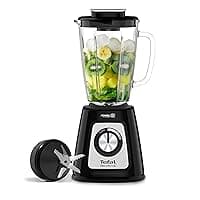
The Tefal Blendforce II is currently £37.00, a significant drop from its 90-day high of £62.49, making this the strongest value proposition in the group right now. Its 800W motor and four removable Powelix blades handle ice crush reliably in the 2L glass jug, and the 1.25L effective capacity is large enough for four servings.
Best for hot soups and batch cookingDaewoo 2-in-1 Soup Maker & Smoothie
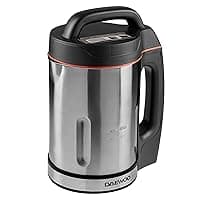
At £39.00, the Daewoo 2-in-1 Soup Maker combines heating and blending in a single 1.6L jug, making up to six portions of fresh soup without transferring hot liquid to a separate container. The auto-stir function and overspill spout are practical safety features for sustained high-temperature use.
Best entry-level jug blender for everyday usePhilips Blender 3000 Series
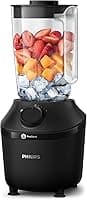
The Philips 3000 Series runs at 450W with a ProBlend system across a 1.9L jug, currently priced at £38.90 against a 90-day low of just £14.00, so watch for a price drop if you are not in a hurry. The single speed plus pulse setup keeps operation simple, and the 1L effective capacity is realistic for two to three servings.
Frequently asked
How many watts do I need in a blender for smoothies?
For smoothies made with fresh or thawed fruit, yoghurt, and liquid, 350W to 450W is sufficient. The Breville Blend Active at 350W and the Philips 3000 Series at 450W both handle this task reliably. If you regularly add frozen fruit straight from the freezer or want to crush ice cubes, step up to at least 500W. For whole nuts, fibrous vegetables, or hot soups, 800W gives you the torque and sustained power needed without straining the motor.
Is a higher-wattage blender worth the extra cost?
It depends entirely on what you blend. A 350W personal blender at around £21 does the job for a daily fresh-fruit smoothie. Spending up to £37 for an 800W model like the Tefal Blendforce II makes sense if you crush ice regularly, blend fibrous greens, or want a machine that handles varied tasks without slowing down. Paying for 800W when you only blend soft fruit is unnecessary. Match the wattage to your most demanding regular task, not to the most demanding task you can imagine.
Can I use a blender to make hot soup in the UK?
Standard blenders are not designed for hot liquids. Filling a standard plastic or glass jug with boiling soup creates pressure that can force the lid off and cause burns. The Daewoo 2-in-1 Soup Maker at £39.00 is purpose-built for this: it heats ingredients inside its 1.6L jug and blends them safely, with an overspill spout as an additional safeguard. If you want to blend hot soup in a conventional blender, allow it to cool to below 60°C first and hold the lid down firmly with a folded tea towel.
What is the difference between a personal blender and a jug blender?
A personal blender, such as the Breville Blend Active, blends directly into a portable 600ml bottle that doubles as a drinking vessel. It is compact, easy to rinse, and ideal for one serving at a time. A jug blender has a larger fixed jar, typically 1.5L to 2L, and is better for batch quantities, soups, or recipes requiring multiple ingredients added in stages. Personal blenders generally run at lower wattage (350W to 550W) and are less suited to ice crushing or tough ingredients.