
Microwave prices on the UK market currently span from £13.50 to £787.99, with the average sitting around £145. That is a wide range, and the type of microwave — solo, grill, or combination — accounts for most of it. This guide breaks down what you actually pay for at each tier, so you can spend confidently rather than guess.
What to look for
01Solo microwaves: the budget-friendly starting point
A solo microwave does one job: it heats food using microwave energy alone. That simplicity keeps costs down. In the UK market, solo models typically sit between £50 and £120, with 800 W output being the most common rating on a 240 V mains supply. At 800 W you get a reasonable boil and reheat speed without the premium price of higher-wattage units. Capacity is usually 20 litres to 25 litres, which fits comfortably on a standard 600 mm worktop. If you mainly reheat leftovers, defrost mince, or warm soup, a solo model is all you need. Spending more than £120 on a solo unit rarely buys you meaningfully faster cooking — you are mostly paying for a fancier digital display or a larger cavity. For most single people or couples in a compact flat, a mid-range solo at around £70 to £80 is the sweet spot.
02Grill microwaves: adding browning without the full combi price
A grill microwave adds a heating element — usually a quartz grill — to the standard microwave cavity. This lets you brown chicken skin, melt cheese on toast, or crisp up a jacket potato top in a way a solo model simply cannot. In the UK, grill microwaves typically cost between £90 and £200. The grill element draws additional wattage on top of the microwave output, so check the combined power rating before buying if you are on a prepayment meter or watching energy costs. Cavity size tends to be 20 litres to 28 litres. The trade-off versus a combination model is that a grill microwave cannot replicate a true fan-assisted oven, so pastry and bread will not crisp evenly. If you want occasional browning but do not need full oven replacement, a grill model at around £100 to £130 hits a practical price point without the complexity of a combi.
03Combination microwaves: why prices climb to £787.99
Combination (combi) microwaves add a convection fan and, in premium models, a steam function or air-fry mode. This is where prices jump sharply. The tracked UK range for this category reaches £787.99 at the top end. That ceiling reflects large-capacity built-in models (45 litres or more) designed to replace a second oven in a fitted kitchen, often with stainless-steel cavities that resist hard-water limescale better than painted interiors. Mid-range combi models at £200 to £350 are countertop units of around 25 litres to 30 litres that can genuinely replace a small fan oven for everyday cooking. Above £400 you are generally paying for a larger cavity, inverter technology for more even heating, or a brand premium. Unless you are fitting a built-in unit or cooking for a large household, the £200 to £300 combi range covers most needs without the steep upper-end cost.
04How discounts and price tracking affect what you pay
Across 35 microwave-related products tracked in the UK, the average discount off the 90-day high price is 11. 8%. That is a meaningful saving if you time your purchase. Prices fluctuate most around sales events, and some products have seen their 90-day low sit well below the current listing price. For example, the biggest current discount tracked is 25.5% off a Waterside 36-piece combination dinner set, saving £13 — a reminder that accessories marketed alongside microwaves are also subject to the same price swings. When comparing microwaves, always check the 90-day low rather than just the current price. A model listed at £149.99 that has dropped to £99 in the past three months is likely to do so again. UK retailers including Amazon, Argos, and Currys all adjust microwave prices regularly, so patience can save you £20 to £50 on a mid-range model.
05Wattage, cavity size, and UK kitchen realities
Two specs drive day-to-day satisfaction more than any other: wattage and cavity size. In the UK, 800 W is the practical minimum for a household microwave — anything below that and reheating times stretch noticeably. Higher-end models run at 900 W or 1,000 W, cutting a few seconds off each cycle, which adds up if you use the appliance multiple times a day. Cavity size matters for fitting a standard dinner plate (typically 26 cm to 28 cm in diameter). A 20-litre cavity is tight for a large plate; 25 litres gives more clearance. If you live in a hard-water area such as London, the East of England, or the South East, a stainless-steel cavity is easier to descale than a painted one. Turntable diameter is worth checking too: a 25.5 cm turntable will not accommodate a 28 cm plate, regardless of the quoted cavity volume.
Our top picks
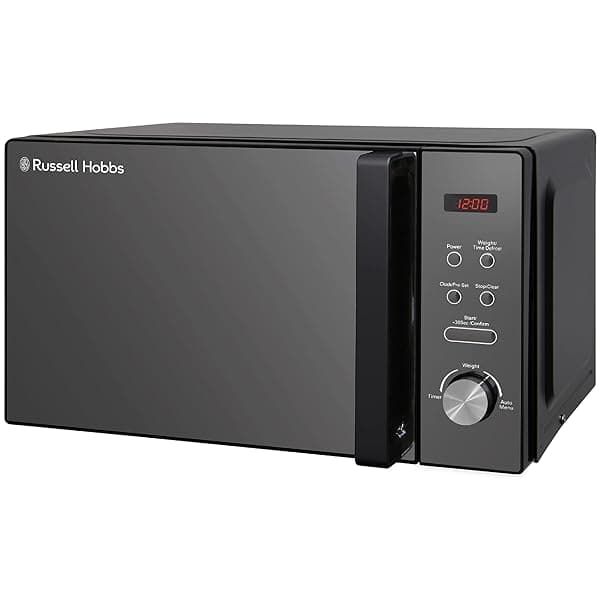
Best solo microwave for everyday reheating on a budget.Russell Hobbs RHM2076B 20 Litre 800
Currently £67.49, the Russell Hobbs RHM2076B has dropped to £23.00 at its 90-day low, so it is worth watching for a price dip. It delivers 800 W across 5 power levels in a 20-litre cavity, with 8 auto-cook menus and automatic defrost. It fits a standard 600 mm worktop slot and is straightforward to clean — a solid choice for a single person or couple who mainly reheat and defrost.
Best solo microwave for precise power control.TOSHIBA 20 Liter 800W Digital Solo
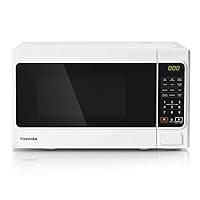
At £79.99, the Toshiba MM-EM20P(WH) stands out with 11 power levels — more than double the 5 levels on most budget rivals — giving finer control over gentle defrosting or simmering sauces. Its 800 W output sits comfortably on a 240 V UK supply, and 6 one-touch preset recipes speed up common tasks. The 90-day low of £37.00 shows this model does go on sale significantly, so setting a price alert before buying is worthwhile.
Best manual-control solo microwave for simplicity.TOSHIBA 20 Liter 800W Manual Control
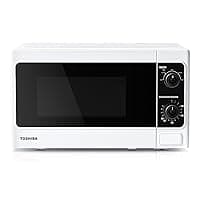
The Toshiba MM-MM20P(WH) costs £69.99 and skips the digital display in favour of straightforward dial controls — ideal if you find menus fiddly. It runs at 800 W with 5 power levels and automatic defrost in a 20-litre cavity. Its compact footprint suits smaller worktops, and the white finish blends into most kitchen colour schemes without drawing attention.
Frequently asked
How much should I spend on a microwave in the UK?
For a solo microwave that handles everyday reheating and defrosting, budget between £60 and £120. If you want browning capability, a grill microwave at £100 to £200 is the next step. Combination models that can replace a small oven start around £200 and rise to £787.99 for large built-in units. The average price across tracked UK products is £145.28, which reflects a mid-range grill or entry-level combi. Spending above £300 makes sense mainly if you need a large cavity or a built-in fit.
What is the difference between a solo, grill, and combination microwave?
A solo microwave uses microwave energy only — good for reheating, defrosting, and boiling. A grill microwave adds a quartz heating element so you can brown and crisp food surfaces. A combination microwave adds a convection fan (and sometimes steam) on top of both, letting it function as a compact fan oven. Each step up adds cost and complexity. Solo models are cheapest and simplest; combination models are the most versatile but require more counter space and carry a higher price tag.
Is 800 W enough for a microwave in the UK?
Yes, for most households. At 800 W on a standard 240 V UK supply, you can reheat a bowl of soup in around 2 minutes and defrost 500 g of mince in roughly 8 to 10 minutes. Stepping up to 900 W or 1,000 W shaves a few seconds per cycle, which matters if you use the microwave heavily throughout the day. Below 800 W, reheating times stretch noticeably and some auto-cook programmes may not work as intended. For a single person or couple, 800 W is the practical sweet spot between speed and running cost.
Do microwave prices drop significantly in UK sales?
They can. Across 35 products tracked in the UK market, the average discount off the 90-day high price is 11.8%. Individual models vary: the Russell Hobbs RHM2076B, for instance, has a 90-day low of £23.00 against a current price of £67.49. UK retailers including Amazon, Argos, and Currys adjust microwave prices regularly around promotional events. Checking a price-tracking tool before buying and setting an alert for your target model can realistically save you £20 to £50 on a mid-range unit.
What cavity size do I need for a standard dinner plate?
Most standard UK dinner plates measure 26 cm to 28 cm in diameter. A 20-litre microwave cavity is tight for larger plates — check the turntable diameter, which is often 25.5 cm, before buying. A 25-litre cavity generally gives enough clearance for a 26 cm plate with room to rotate. If you regularly heat large casserole dishes or family-sized portions, look for a 28-litre to 32-litre cavity. Cavity volume alone does not tell the whole story; always check the quoted turntable diameter in the product specifications.