
Capacity is the single most important number on a microwave's spec sheet, yet most shoppers ignore it until the turntable won't fit a dinner plate. UK countertops are tight, and a 20-litre solo model covers the majority of households, but a larger family or a compact flat galley kitchen may need a different answer entirely.

What to look for
01Capacity in litres: what actually fits inside
Microwave capacity is measured in litres, but what matters in practice is the turntable diameter and the internal height. A 20-litre cavity typically has a turntable of around 24–25 cm, which comfortably holds a standard 23 cm dinner plate or a 9-inch (23 cm) pizza. If you regularly heat large casserole dishes or tall mugs, look for 25 litres or above. For a single person or couple in a flat with a narrow galley kitchen, a compact 17–20 litre unit is usually sufficient and takes up less than 44 cm of worktop width. Families of four or more will find a 25–30 litre cavity far more practical for batch reheating. The Hisense H20MOBP1HIUK, for example, measures H24.1 x W43.4 x D32.9 cm, which slots neatly under most UK overhead cupboards without modification.
02Wattage and cooking speed on UK 240 V mains
On the UK 240 V supply, microwave wattage runs from around 700 W at the budget end to 1,000 W or more on premium combi models. The difference is real: an 800 W microwave reheats a bowl of soup in roughly 90 seconds; a 700 W model takes closer to two minutes for the same task. The Hisense model here uses 700 W with inverter technology, which delivers continuous, even power rather than cycling on and off, so food heats more uniformly even at lower wattage. The Russell Hobbs and Toshiba solo models all run at 800 W, which is the sweet spot for speed without pushing your electricity bill significantly. At 24p per kWh, a two-minute reheat at 800 W costs less than 1p, so wattage affects time more than running cost.
03Power levels: how many do you actually need
More power levels give you finer control over delicate tasks such as softening butter, melting chocolate, or defrosting fish without cooking the edges. Five power levels, as found on the Russell Hobbs RHM2076B and the Hisense, cover the essentials: full power, reheat, simmer, defrost, and low. The Toshiba MM-EM20P(WH) steps up to 11 power levels, which is genuinely useful if you cook from scratch in the microwave rather than just reheating. For most households, five levels is adequate. The automatic defrost function, present on all four solo models here, adjusts power automatically based on the weight you enter, which is more reliable than guessing a manual setting. If you live in a hard-water area, note that limescale build-up inside the cavity is less of an issue with microwaves than with kettles, but wiping the interior regularly still matters for hygiene.
04Preset programmes and ease of use
Auto-cook menus let you press one button and walk away. The Russell Hobbs RHM2076B and its silver sibling the RHM2076S-AZ both offer 8 auto-cook menus covering common tasks such as baked potatoes, pizza, and beverages. The Toshiba MM-EM20P(WH) goes further with 6 one-touch express-cook presets plus a dedicated defrost mode. Manual-dial models like the Toshiba MM-MM20P(WH) skip presets entirely, which some users prefer for simplicity, though you lose the convenience of weight-based defrost. Digital displays with a clock and timer are standard across the digital models here and are particularly useful in a busy kitchen where the microwave doubles as a kitchen clock. If you share your kitchen with older relatives or children, a simple interface with fewer buttons is often the better choice.
Our top picks
Best for even reheating in a compact kitchenHisense 700 Watts 20 Litre Inverter

The Hisense H20MOBP1HIUK uses inverter technology at 700 W, delivering continuous power rather than pulsed cycles, which means food heats more evenly from edge to centre. Its footprint of W43.4 x D32.9 cm fits under standard 600 mm UK overhead cupboards with room to spare. Five power levels and automatic defrost cover everyday tasks, and the black finish suits modern kitchen schemes.
Best budget solo microwave for everyday reheatingRussell Hobbs RHM2076B 20 Litre 800
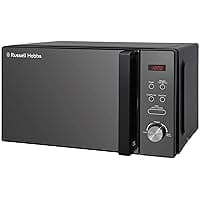
The Russell Hobbs RHM2076B delivers 800 W across a 20-litre cavity with 5 power levels and 8 auto-cook menus, making it one of the most fully featured options at this price point. Automatic defrost adjusts power by weight, which removes the guesswork. The digital display includes a clock and timer, and the interior is designed for straightforward wiping down.
Best for precise control and frequent microwave cookingTOSHIBA 20 Liter 800W Digital Solo
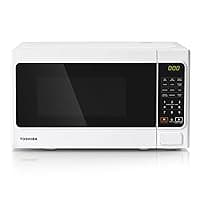
The Toshiba MM-EM20P(WH) stands out with 11 power levels, the widest range in this selection, giving you genuine control over delicate tasks such as melting chocolate or softening cream cheese. Six one-touch express-cook presets and an 800 W output across a 20-litre cavity make it equally capable for quick reheating. The digital display is clear and the interior accommodates a 9-inch (23 cm) pizza without difficulty.
Best manual-control microwave for simplicityTOSHIBA 20 Liter 800W Manual Control
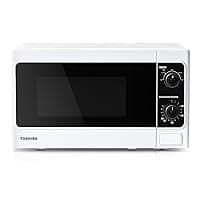
The Toshiba MM-MM20P(WH) uses a rotary dial rather than a touchpad, which makes it straightforward to operate without reading a manual. At 800 W with a 20-litre cavity and 5 power levels, it handles everyday reheating and defrosting without fuss. Its compact dimensions suit a galley kitchen or student flat where worktop space is limited, and the white finish keeps it unobtrusive.
Frequently asked
What litre size microwave do I need for a family of four?
For a family of four, a 25-litre cavity or larger is the practical minimum, as it accommodates bigger dishes and allows you to reheat multiple portions at once. The 20-litre models in this guide suit one or two people comfortably. If you regularly use large casserole dishes or want to fit a 30 cm plate on the turntable, step up to a 25-30 litre model. For a single person or couple, 20 litres is sufficient for the vast majority of tasks.
Is 700 W or 800 W better for a microwave?
800 W heats food faster than 700 W on the UK 240 V supply, which matters for everyday reheating. However, a 700 W inverter microwave, such as the Hisense H20MOBP1HIUK, can outperform a pulsed 800 W model for even heating because inverter technology delivers continuous power rather than cycling on and off. For speed alone, 800 W wins. For texture and uniformity, inverter technology at 700 W is often the better result.
Will a 20-litre microwave fit under UK kitchen cupboards?
Most 20-litre solo microwaves are around 24-26 cm tall, which fits comfortably under standard UK overhead cupboards installed at 45-50 cm above the worktop. The Hisense H20MOBP1HIUK, for example, measures H24.1 cm, so it clears the typical gap with ease. Always check the height specification before buying, particularly in older kitchens where cupboard clearance may be lower than current building standards.
How many power levels do I need on a microwave?
Five power levels cover the essentials for most households: full power for fast reheating, a mid setting for simmering, a low setting for defrosting, and intermediate steps for delicate tasks. If you cook from scratch in the microwave, melt chocolate, or proof dough, 11 power levels, as on the Toshiba MM-EM20P(WH), give you meaningfully finer control. For straightforward reheating and defrosting, five levels is entirely adequate.
What is the difference between a solo microwave and a combi microwave?
A solo microwave uses microwave energy only, making it ideal for reheating, defrosting, and simple cooking. A combi microwave adds a grill element, a convection oven, or both, allowing you to brown and crisp food as well as heat it. Solo models are smaller, cheaper, and simpler to use. All four microwave picks in this guide are solo models, suited to households that already have an oven and want a dedicated reheating appliance.