
Three microwave types sit on UK shelves, and choosing the wrong one means paying for features you never use or missing the ones you need. A solo unit covers everyday reheating and defrosting on a standard 240V socket, a grill model adds browning, and a combination oven replaces a second oven entirely. Knowing which fits your cooking habits takes about two minutes.
What to look for
01Wattage and how quickly your food heats
Most solo microwaves sold in the UK run at 700 W or 800 W on a standard 240V mains supply. The difference matters more than it sounds: an 800 W model heats a bowl of soup in roughly 90 seconds, while a 700 W unit takes closer to two minutes for the same result. For a single person or couple reheating leftovers, 700 W is perfectly adequate. For a busy household cooking rice, defrosting chicken breasts, or heating multiple portions back-to-back, 800 W is worth the marginal extra running cost. Inverter technology, found on some models like the Hisense H20MOBP1HIUK, delivers power more evenly rather than cycling on and off, which reduces hot spots in denser foods such as casseroles. If you live in a hard-water area and use your microwave to heat water frequently, a higher wattage also means less time with the element running, which can reduce limescale build-up inside the cavity over time.
02Cavity capacity and worktop footprint
The most common cavity size in the UK market is 20 litres, which comfortably fits a standard dinner plate and handles a 23 cm casserole dish. If your kitchen runs to a 600 mm-deep worktop unit, check the external depth of any model before buying: the Hisense H20MOBP1HIUK, for example, measures 43.4 cm wide by 32.9 cm deep, which sits neatly under most standard overhead cupboards. Larger combination ovens can push 50 cm or more in depth, which may overhang a standard worktop. A 20-litre solo microwave is the practical minimum for a family; if you regularly cook whole joints or large baking dishes, a 25-litre or 30-litre combi model makes more sense. Compact models around 17 litres suit a studio flat or office kitchen where worktop space is at a premium.
03Solo vs grill vs combination: what each type actually does
A solo microwave uses microwave energy only. It reheats, defrosts, and cooks moist foods such as vegetables, fish, and porridge very well, but it cannot brown or crisp anything. A grill microwave adds a heating element, usually quartz or ceramic, that sits at the top of the cavity. You can use it to finish a gratin, crisp bacon, or brown the top of a lasagne without turning on your main oven. A combination microwave pairs microwave energy with convection heat, functioning as a compact second oven. You can bake, roast, and grill, which makes it genuinely useful in a flat where a full-size oven is the only cooking appliance. The trade-off is price and complexity: combination models cost significantly more and have more settings to learn. For most UK households that already own a full cooker, a well-specified solo unit at 800 W with auto-defrost and several power levels covers 90 per cent of daily microwave tasks.
04Power levels and preset programmes
Five power levels is the standard on entry-level models, and it is enough for most tasks: full power for reheating, 50-60 per cent for defrosting, and lower settings for gentle warming of sauces or melting butter. More power levels, such as the 11 offered on the Toshiba MM-EM20P, give finer control, which is useful if you cook delicate foods like fish or chocolate-based dishes in the microwave. Preset auto-cook menus take the guesswork out of common tasks: you select the food type, enter the weight, and the microwave calculates time and power automatically. Eight presets, as found on the Russell Hobbs RHM2076B and RHM2076S-AZ, cover the most common UK uses including jacket potatoes, soup, and frozen vegetables. Six presets, as on the Toshiba MM-EM20P, still handle everyday cooking. If you use your microwave mainly for reheating and the occasional defrost, five levels and a manual timer are all you need.
05Ease of cleaning and interior materials
Microwave interiors accumulate splattered food quickly, and a cavity that is hard to wipe down becomes a hygiene problem. Smooth, flat interior walls with no exposed screws or ridges are easiest to clean. Several models in this category are marketed as 'Easy Clean', which typically means a smooth enamel or acrylic coating rather than a textured painted steel surface. A removable glass turntable is standard and can go in the dishwasher. The door seal and the area around the door hinge collect grease, so check that the door opens cleanly and the frame is accessible. If you cook a lot of fish or strong-smelling foods, look for a model with a deodorising function or simply leave the door ajar after use to ventilate the cavity. In hard-water areas, wipe the interior dry after steaming foods to prevent limescale deposits on the cavity walls.
Our top picks
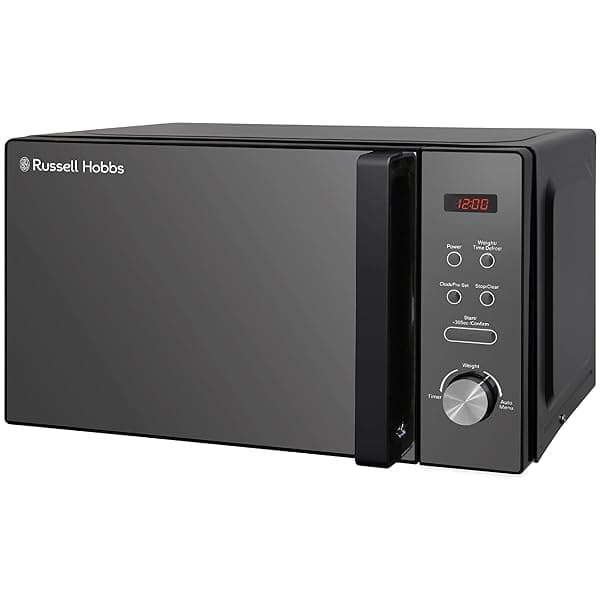
Best for everyday reheating in a mid-sized kitchenRussell Hobbs RHM2076B 20 Litre 800
The Russell Hobbs RHM2076B runs at 800 W across 5 power levels and offers 8 auto-cook menus, covering jacket potatoes, soup, and frozen vegetables without manual calculation. The 20-litre cavity fits a standard dinner plate, and the digital display with clock and timer keeps the worktop tidy. The flat-black finish suits most kitchen colour schemes, and the smooth interior wipes down in seconds.
Best for precise cooking with more power-level controlTOSHIBA 20 Liter 800W Digital Solo
Toshiba's MM-EM20P steps up to 11 power levels, giving noticeably finer control over delicate tasks such as softening butter or defrosting fish without cooking the edges. The 20-litre cavity handles a 23 cm pizza, and 6 one-touch express-cook presets speed up common jobs. The digital display is clear, and the white finish keeps things neutral on a busy worktop.
Best for even heating with inverter technologyHisense 700 Watts 20 Litre Inverter

The Hisense H20MOBP1HIUK uses inverter-driven 700 W output to deliver continuous, steady power rather than cycling on and off, which reduces hot and cold spots in denser dishes like casseroles or rice. At 43.4 cm wide and 32.9 cm deep, it fits comfortably on a standard 600 mm worktop. Automatic defrost and 5 power levels keep operation straightforward, and the black finish is compact and unobtrusive.
Best budget solo microwave for a small flat or officeTOSHIBA 20 Liter 800W Manual Control
Toshiba's MM-MM20P delivers 800 W in a compact 20-litre body with manual dial controls, making it one of the simplest units to operate day to day. Five power levels and automatic defrost cover the basics, and the white finish suits a studio kitchen or office worktop. Manual controls mean fewer electronics to go wrong, and the smooth interior cleans quickly after a splatter.
Frequently asked
What is the difference between a solo microwave and a combination microwave?
A solo microwave uses only microwave energy to heat food. It reheats, defrosts, and cooks moist foods efficiently but cannot brown or crisp. A combination microwave adds convection heat and sometimes a grill element, letting it bake, roast, and brown in the same cavity. Combination models cost more and take up more worktop space. For a household that already has a full cooker, a solo 800 W unit handles the vast majority of daily microwave tasks without the added complexity.
Is 700 W or 800 W better for a microwave?
800 W heats food faster and is the more practical choice for a busy household. A 700 W model takes roughly 15-20 per cent longer to reach the same result, which adds up if you are reheating multiple portions. That said, 700 W with inverter technology, as used in the Hisense H20MOBP1HIUK, can produce more even results than a basic 800 W unit that cycles power on and off. For a single person or couple, 700 W is entirely sufficient.
What size microwave do I need for a standard UK kitchen?
A 20-litre cavity is the most practical size for most UK households. It fits a standard 26 cm dinner plate and a 23 cm casserole dish, and the external dimensions of most 20-litre models sit comfortably under a standard 600 mm overhead cupboard. If you regularly cook large joints or use the microwave as a second oven, a 25-litre or 30-litre model is worth considering, but check the external depth before buying, as larger units can overhang a standard worktop.
How many power levels do I need on a microwave?
Five power levels cover everyday use: full power for reheating, around 50 per cent for defrosting, and lower settings for gentle warming. If you cook delicate foods such as fish, chocolate, or egg-based dishes in the microwave, 11 power levels, as offered by the Toshiba MM-EM20P, give meaningfully finer control and reduce the risk of overcooking edges while the centre is still cold. For straightforward reheating and defrosting, five levels are all most households need.
Are microwaves with auto-defrost worth it?
Yes, for most UK households. Auto-defrost calculates defrosting time based on the weight you enter, adjusting power automatically to thaw food evenly without starting to cook the edges. Manual defrosting requires you to check and pause the microwave repeatedly. Auto-defrost is particularly useful for chicken breasts, mince, and fish fillets, where uneven thawing is a food-safety concern. Most models in this category include it as standard, so it is rarely a reason to pay a premium on its own.