
A good multi-cooker replaces at least 7 separate appliances on a UK worktop, cutting both clutter and energy bills. This guide covers eight models across a wide price range, from a compact 40cm electric pan to a 6.5-litre 10-in-1 unit, so you can match capacity, wattage, and function count to your household size and cooking habits.
What to look for
01Capacity and household size
Capacity is the first number to check. A 5.7-litre pot comfortably feeds four to six people, while a 6.5-litre unit handles batch cooking for larger families or meal-preppers. At the smaller end, a unit rated for five portions suits a household of three to four. Bear in mind that pressure cookers should never be filled beyond two-thirds for liquid-heavy dishes, so a stated 6-litre capacity effectively gives you around 4 litres of usable space for soups and stews. If your kitchen has limited worktop depth, check the footprint too: a 40 cm pan-style cooker sits differently to a tall 22 cm pressure-cooker body. Most UK fitted kitchens have 60 cm deep worktops, so a unit wider than 40 cm may overhang or block cupboard doors.
02Wattage and running costs on UK mains
UK mains runs at 240V, so wattage directly determines how quickly a multi-cooker reaches pressure or sautéing temperature. A 1,350W unit like the Morphy Richards 10-in-1 reaches cooking temperature faster than a lower-wattage model, which matters when you are cooking after work. Pressure cookers claim to cut cooking times by up to 70 percent compared with conventional hob methods, which offsets the higher draw during the pressurising phase. For slow-cook mode, wattage drops to around 200-300W, making it cheaper per hour than a conventional oven. If you are on a time-of-use energy tariff, scheduling slow-cook overnight on off-peak electricity is a practical saving. Always check the plug is a standard UK three-pin BS 1363 type before buying from a non-UK marketplace listing.
03Function count: how many programmes do you actually use?
Function counts range from a basic pressure-and-slow-cook pairing up to 14-in-1 combinations that include bread-making, yoghurt fermentation, and cake baking. More programmes are only useful if the presets are calibrated correctly for UK ingredients and portion sizes. A 7-in-1 covering pressure cook, slow cook, rice, sauté, steam, yoghurt, and warm covers the majority of everyday cooking tasks. Going to 10-in-1 or 14-in-1 adds roasting, frying, and baking, which can genuinely replace an oven for smaller households. Check whether the control panel is LED or mechanical: an LED panel with labelled presets is easier to read in a dimly lit kitchen. Dishwasher-safe inner pots are worth prioritising if you cook sticky dishes like rice or porridge, especially in hard-water areas where mineral deposits build up quickly on non-stick surfaces.
04Inner pot material and hard-water durability
Inner pots come in non-stick aluminium, stainless steel, or a combination. Stainless steel is more durable and tolerates the limescale-heavy water found across much of England and Wales, but food can stick without oil. Non-stick aluminium is easier to clean and performs well for rice and yoghurt, but the coating degrades faster if you use metal utensils or run it through a dishwasher repeatedly. Some models offer a stainless steel outer with a non-stick inner, giving a middle ground. If you live in a hard-water area, descale the sealing ring and steam valve every four to six weeks to maintain pressure performance. A removable, dishwasher-safe lid and pot reduce the effort of that maintenance significantly.
Our top picks
Best for everyday family pressure cookingInstant Pot Duo 7-in-1 Electric Multi-Cooker
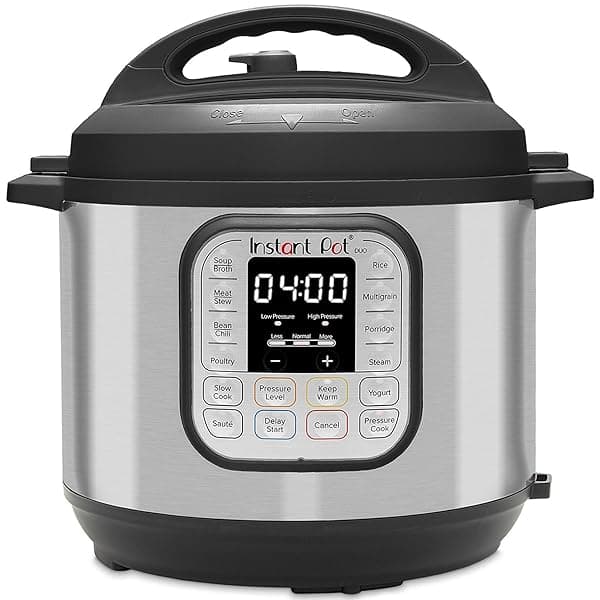
The Instant Pot Duo covers 7 functions in a 5.7-litre brushed stainless steel body, enough for four to six portions. The sauté function means you can brown onions before pressure cooking without dirtying a separate pan, and the yoghurt programme is a genuine bonus for households that go through a lot of it. The inner pot and lid are dishwasher-safe, which matters in hard-water areas where hand-washing leaves limescale marks.
Best for replacing your oven on weeknightsMorphy Richards Multifunction 10-in-1 Food Multicooker
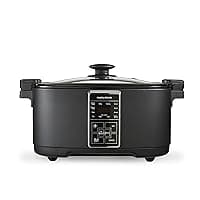
At 1,350W and 6.5 litres, the Morphy Richards 10-in-1 is the highest-capacity model here and adds frying and roasting to the usual pressure and slow-cook repertoire. The LED control panel is clearly labelled, and the aluminium non-stick pot is dishwasher-safe. Ten functions in a single unit is a credible argument for clearing out several single-purpose appliances from a crowded UK kitchen.
Best for batch cooking and bread makingDrew&Cole CleverChef 14-in-1 Multi Cooker
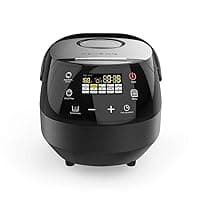
The Drew and Cole CleverChef reaches 14 functions, including a bread-maker programme that most rivals omit. It is rated for five portions, making it practical for a family of four with leftovers. Stew, roast, bake, and soup-maker modes cover the kind of weekend cooking that would otherwise tie up an oven for hours, and the single-pot approach keeps washing up to a minimum.
Frequently asked
What size multi-cooker do I need for a family of four?
A 5-litre to 6-litre inner pot is the practical minimum for a family of four, particularly for pressure-cooked dishes where you cannot fill beyond two-thirds. That means a stated 6-litre pot gives roughly 4 litres of usable space for soups and curries. For batch cooking or households of five or more, a 6.5-litre unit gives noticeably more headroom. Smaller 3-litre models suit couples or single-person households but struggle with a full Sunday roast.
Is a multi-cooker cheaper to run than an oven in the UK?
In most cases, yes. A multi-cooker drawing 1,000-1,350W and reaching pressure in 10-15 minutes uses considerably less energy than a conventional oven running at 2,000-2,500W for an hour or more. Slow-cook mode drops to around 200-300W, which is very economical, especially if you run it overnight on an off-peak tariff. Exact savings depend on your energy tariff and what you are cooking, but for stews, pulses, and rice the multi-cooker is almost always the more efficient choice.
Can I use a multi-cooker in a hard-water area?
Yes, but you need to maintain it more carefully. Limescale builds up on the sealing ring, steam valve, and inner pot, which can reduce pressure performance over time. Descale every four to six weeks using a solution of water and white vinegar run through a steam cycle. A stainless steel inner pot resists limescale staining better than a non-stick aluminium one. Choosing a model with a dishwasher-safe pot and removable lid makes the regular clean much less of a chore.
How many functions do I actually need in a multi-cooker?
For most UK households, seven functions cover daily cooking: pressure cook, slow cook, rice, sauté, steam, yoghurt, and keep-warm. Going to 10 or 14 functions adds roasting, frying, baking, and bread-making, which is worthwhile if you want to reduce oven use. Functions you will rarely use add complexity to the control panel without adding value, so be honest about your cooking habits before paying a premium for a higher function count.
Are multi-cooker inner pots dishwasher safe?
Many are, but check the specific model. Non-stick aluminium pots are often listed as dishwasher-safe but degrade faster with repeated high-temperature dishwasher cycles, particularly in hard-water areas where the rinse water leaves mineral deposits. Stainless steel pots are more dishwasher-tolerant. The sealing ring and steam valve should be removed and washed separately after every use regardless of material, as food residue trapped there affects both hygiene and pressure performance.