
A multi-cooker replaces up to 7 appliances in one footprint, which matters when your worktop runs to 60cm. Prices in this round-up start at £33.05 and reach £119.99, so there is a realistic option for every budget and kitchen size in the UK.
What to look for
01Footprint and capacity: fitting your worktop
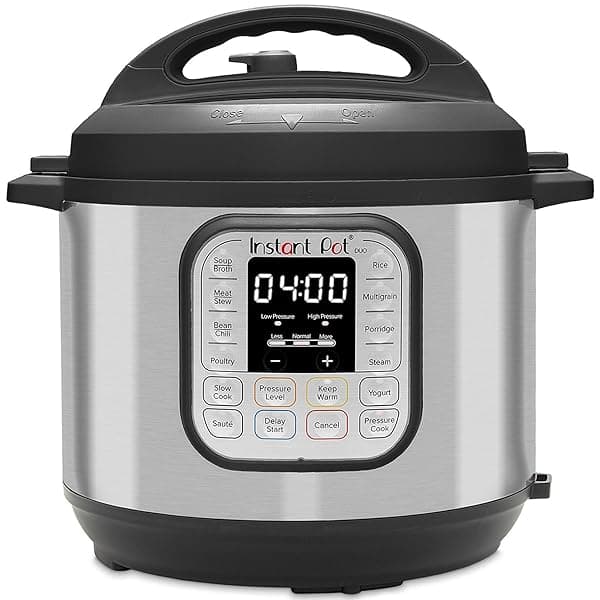
Most UK kitchens have worktops around 600mm deep, so the physical base of a multi-cooker matters as much as its litre capacity. A 5.7L Instant Pot Duo, for example, sits on a roughly 33cm-diameter base, which leaves room beside a kettle without blocking a wall socket. Larger 8L models push closer to 38cm across and can crowd a galley kitchen. As a rule, a 5–6L pot suits two to four people and fits comfortably on a standard UK worktop; step up to 6.5–8L only if you batch-cook regularly. Also check the height with the lid on: some models need 50cm of clearance above to open safely, which rules out low overhead cupboards. The Quest 30cm x 30cm pan is the flattest option here and slides under most cupboards with ease.
02Wattage and running costs on UK 240V mains
All the models here run on the UK's 240V supply, but their wattage varies from around 700W up to 1,500W. Higher wattage means faster heat-up and pressure build, which saves time but draws more from the grid. The Quest Professional runs at 1,500W, reaching 240°C for searing, while most pressure-cooker-style pots sit between 1,000W and 1,200W. At current UK electricity rates (roughly 24p per kWh), a 1,000W cooker running for 30 minutes costs about 12p, compared to 18p for a 1,500W model. For everyday slow cooking on the low setting, wattage drops significantly, making multi-cookers cheaper to run than a conventional oven for batch meals.
03Number of functions: genuine versatility vs. spec padding
A 14-in-1 label sounds impressive, but check whether the extra modes are genuinely distinct. The Drew&Cole CleverChef lists bread making and baking alongside pressure cooking and slow cooking, which are real additions. The Instant Pot Duo's 7 functions cover pressure cook, slow cook, rice, sauté, steam, yoghurt, and warm, which most households actually use. If you live in a hard-water area such as London or the South East, a steam function is particularly useful because you can descale the inner pot separately rather than running a full cycle. Prioritise functions you will use at least weekly; every extra mode adds menu complexity and, in some cases, a larger footprint.
04Ease of cleaning in a small kitchen
Counter space is tight, so a multi-cooker that is awkward to clean will quickly end up in a cupboard. Look for a dishwasher-safe inner pot: both the Instant Pot Duo and the Midea 6L explicitly state dishwasher-safe stainless steel pots, which is a genuine time-saver. Non-stick coatings, as on the Quest and Midea, wipe clean faster but can scratch if you use metal utensils. The sealing ring on pressure cookers absorbs odours over time; removable, washable rings (standard on Instant Pot) prevent last night's curry flavouring your morning porridge. In a small kitchen without a dishwasher, a smooth inner pot with no rivets is the easiest to hand-wash.
Our top picks
Best for everyday family cooking in a compact kitchenInstant Pot Duo 7-in-1 Electric Multi-Cooker
Seven cooking modes, a dishwasher-safe stainless steel inner pot, and a removable sealing ring make it the most practical all-rounder for UK households cooking for two to four people. The 5.7L capacity hits the sweet spot between useful volume and a manageable worktop footprint.
Best for batch cooking on a budgetDrew&Cole CleverChef 14-in-1 Multi Cooker
The Drew&Cole CleverChef 14-in-1 is currently £79.99, above its 90-day low but still reasonable for 14 cooking modes including bread making and baking. Its large capacity is designed to cook five portions in one go, making it ideal for meal-prepping families.
Frequently asked
What size multi-cooker do I need for a small UK kitchen?
For one or two people, a 5–6L pot is sufficient and has a base diameter of roughly 30–33cm, which fits on most UK worktops without blocking a plug socket. Families of four or more may want 6.5L or above, but check the base dimensions against your available worktop space before buying. Also measure the clearance above your worktop to the underside of any overhead cupboards: most models need at least 45–50cm of vertical space to open the lid safely.
Are multi-cookers cheaper to run than an oven in the UK?
Generally, yes. A typical multi-cooker draws 1,000–1,200W and reaches pressure in 10–15 minutes, then maintains temperature at a lower wattage. A conventional electric oven uses 2,000–2,500W and heats a large cavity. At around 24p per kWh, a 30-minute pressure-cook cycle costs roughly 12–15p, compared to 30–40p for an oven doing the same job. Slow-cook mode draws even less, often under 200W, making it one of the cheapest cooking methods available on UK mains.
Is a multi-cooker safe to use on a UK kitchen worktop?
Yes, provided you follow a few practical steps. Place the unit on a heat-resistant surface at least 30cm from walls and cabinets. Ensure the steam release valve points away from overhead cupboards, as repeated steam exposure can warp MDF cabinet bases common in UK fitted kitchens. All models listed here are designed for 240V UK mains and carry CE or UKCA marking. Never leave a pressure cooker unattended during the pressure-build phase if you are new to the appliance.
Do multi-cookers work well in hard-water areas like London?
They do, but limescale builds up faster on heating elements and steam valves in hard-water areas. Run a descaling cycle every four to six weeks using a solution of 250ml white vinegar and 250ml water on the steam setting. Removable sealing rings and dishwasher-safe inner pots, as found on the Instant Pot Duo and Midea 6L, make this maintenance much easier. Avoid abrasive cleaners on non-stick coatings, as scratches accelerate limescale adhesion.