
A good kettle is one of the hardest-working appliances on your worktop, and with prices ranging from £13.65 to £27.98 in this guide, there is a solid option for every budget. UK mains power runs at 240V, so most full-size kettles hit 3kW and boil 1.7 litres in around three minutes. The main decisions are material, capacity and whether you need travel-friendly dual voltage.
What to look for
01Wattage and boil time
On the UK 240V mains supply, a 3kW element is the practical ceiling for a domestic kettle and is what you will find in most full-size models here. At 3kW, a full 1.7-litre load reaches 100°C in roughly three minutes. Drop to 1kW, as with the Russell Hobbs travel kettle, and the same volume would take around nine minutes, though that model is only designed for 0.85 litres. Higher wattage costs slightly more to run per boil but saves time, which matters if you are making multiple rounds of tea for a household. Check your kitchen's circuit if you run a toaster or microwave on the same socket strip, as three high-wattage appliances together can trip a 13-amp fuse. For most people, 3kW is the right choice.
02Capacity and household size
The standard UK jug kettle holds 1. 7 litres, enough for six to seven mugs in one boil. That suits most households. If you live alone, boiling a full 1.7 litres every time wastes energy; look for a model with clear water-level markings so you fill only what you need. The Chefman glass kettle holds 1.8 litres, giving a little extra headroom for larger gatherings. At the other end, the Russell Hobbs travel kettle holds just 0.85 litres, which is fine for one or two cups and fits neatly in a 600mm-wide caravan cupboard. Capacity also affects footprint: a 1.7-litre jug kettle typically measures around 22 cm tall and 16 cm wide at the base, so measure your worktop space before buying.
03Material: glass, stainless steel or plastic
Plastic kettles are the lightest and cheapest, but lower-quality plastics can impart a taste to water, especially when new. Look for BPA-free labelling as a minimum. Stainless steel interiors, as found on the Cosori brushed-steel model, mean no plastic ever contacts the water, which is reassuring if you live in a hard-water area and descale regularly with citric acid or vinegar. Glass bodies let you see the water level and limescale build-up at a glance, though borosilicate glass (used in the Chefman) is more resistant to thermal shock than standard glass. In hard-water areas such as London, the South East and the Midlands, a removable, washable anti-scale filter is worth prioritising regardless of the outer material, as it keeps sediment out of your mug.
04Filters and ease of cleaning
A removable, washable anti-scale filter is a small feature that makes a real difference in hard-water areas. Most models here include one. The Cosori glass kettle adds a stainless-steel inner lid and a glass spout, reducing the plastic surfaces that water touches. The Chefman goes further with a fully removable lid for easy cleaning inside the borosilicate glass body. If you descale monthly, as recommended in hard-water regions, a wide opening or removable lid saves a lot of frustration. Avoid models where the filter is glued in or awkward to reach. A quick rinse of the filter every two weeks and a full citric-acid descale every four to six weeks will keep any kettle performing well.
05Travel and dual-voltage kettles
If you camp, caravan or travel abroad frequently, a standard 3kW UK kettle will not work safely on European 220V supplies or US 110V circuits without an adapter, and even then wattage limits apply. The Russell Hobbs travel kettle (model 23840) is dual voltage, meaning it switches between voltage ranges automatically, and its 1000W draw is low enough for caravan hook-up points, which are typically limited to 16 amps. At 0.85 litres it packs into a bag alongside two included cups and spoons. At £14.99 it is also the most affordable option here for a secondary kettle. It is not a replacement for a full-size 3kW model at home, but as a travel companion it is hard to beat.
Our top picks
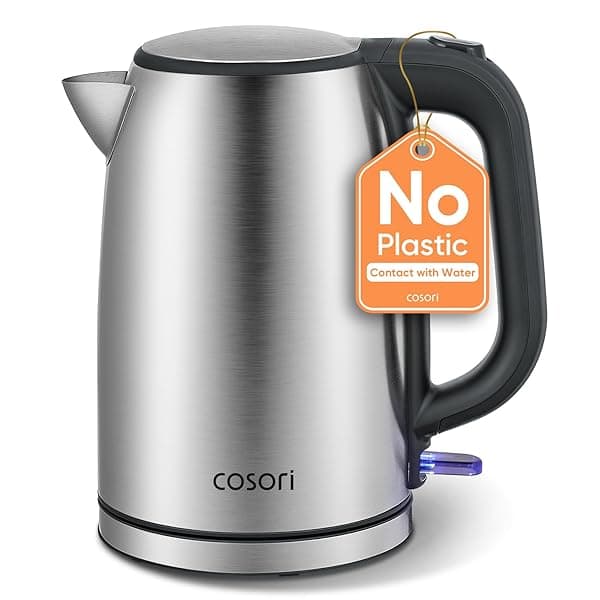
Best for those who want no plastic touching their waterCosori Kettle
Priced at £27.98, currently at its 90-day low, the Cosori brushed stainless-steel kettle has a plastic-free water-contact zone, a durable stainless-steel filter and a 3000W element that boils 1.7 litres quickly. If you live in a hard-water area and descale regularly, the all-metal interior makes cleaning with citric acid straightforward and keeps metallic or plastic tastes out of your brew.
Best budget kettle for everyday useRussell Hobbs Textures Electric 1.7L Cordless
At £18.75, the Russell Hobbs Textures 21271 has dropped from a 90-day high of £18.99 and hit a low of £8.00 in that period, making it one of the best-value 3kW kettles available. The 1.7-litre capacity suits most households, the removable washable anti-scale filter is easy to rinse under the tap, and the push-to-open lid is a practical touch. Over 35,000 Amazon UK reviews back up its reliability as a no-fuss daily driver.
Best travel and caravan kettleRussell Hobbs Electric 0.85L Travel Kettle
The Russell Hobbs 23840 runs at 1000W on dual voltage, making it safe for caravan hook-ups and overseas sockets without a separate transformer. Its 0.85-litre capacity is enough for two cups, and it comes with two cups and spoons in the box. At £14.99, down from a 90-day high of £17.60, it is compact enough to fit in a 600mm caravan cupboard and light enough to pack in luggage without fuss.
Best glass kettle on a tight budgetCosori Kettle
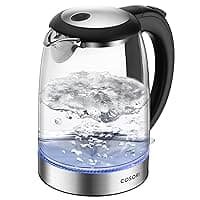
At £21.97, the Cosori black glass kettle sits well below its 90-day high of £29.99. It runs at 3000W, has a food-grade stainless-steel filter and inner lid, and the glass spout means no plastic contacts the water stream. The no-splash design and LED ring make it easy to use in low light.
Best white kettle for a clean kitchen aestheticRussell Hobbs Honeycomb Electric 1.7L Cordless
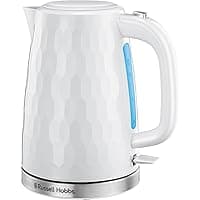
Its 3kW element boils 1.7 litres fast, the removable washable anti-scale filter is straightforward to clean, and the matt-and-gloss honeycomb finish resists fingerprints better than plain gloss plastic. It dropped to £17.60 in the past 90 days, so it is worth setting a price alert if you can wait.
Frequently asked
What wattage kettle should I buy for a UK home?
For a standard UK home, 3kW (3000W) is the best choice. The UK mains supply runs at 240V, which supports a 3kW element without any issues on a standard 13-amp plug. A 3kW kettle boils 1.7 litres in roughly three minutes. Lower-wattage models (1kW or 1500W) take significantly longer and are mainly designed for travel or caravans where the power supply is limited. All the full-size kettles in this guide run at 3kW.
Is a glass or stainless steel kettle better?
Both are better than basic plastic for taste and hygiene. Glass lets you see limescale build-up and water level clearly, and borosilicate glass handles repeated boiling without cracking. Stainless steel is more durable if knocked and, when the interior is fully stainless (as with the Cosori brushed-steel model), no plastic ever contacts the water. In hard-water areas, either material is easier to descale than plastic. The choice often comes down to looks: glass suits modern kitchens, brushed steel suits industrial or Scandi styles.
How often should I descale my kettle in a hard-water area?
In hard-water areas, such as London, the South East, East Anglia and the Midlands, descale every four to six weeks. Use a citric-acid descaler or a solution of one part white vinegar to one part water: fill to the minimum line, boil, leave for 30 minutes, then rinse thoroughly. A removable anti-scale filter, fitted to most kettles in this guide, catches loose limescale before it reaches your mug and should be rinsed under the tap every one to two weeks.
Can I use a UK kettle abroad?
A standard UK 3kW kettle is not safe to use abroad without checking the local voltage and socket type. Most European countries use 220V, which is close enough for most appliances, but the plug shape differs and wattage limits in hotel rooms or campsites may be lower than 3kW. For reliable travel use, choose a dual-voltage kettle such as the Russell Hobbs 23840, which adjusts automatically and draws only 1000W, well within most caravan and hotel circuit limits.
What capacity kettle do I need?
For one or two people, a 1.7-litre kettle is more than enough: fill it to the one-cup or two-cup mark rather than boiling a full load every time, which saves energy. For families of four or more who make tea in rounds, a 1.7-litre or 1.8-litre model covers most needs in a single boil. The 0.85-litre Russell Hobbs travel kettle is only suitable as a secondary or travel kettle, not as a main household appliance.