
Choosing between carbon steel and stainless steel comes down to one trade-off: edge sharpness versus everyday practicality. Carbon steel holds a finer edge but needs drying after every use to prevent rust, while stainless steel handles a British kitchen's damp worktops and dishwasher habits with far less fuss. Most home cooks are better served by stainless, but serious enthusiasts will find carbon steel worth the extra care.
What to look for
01Blade material and what it means for sharpness
Carbon steel contains a higher proportion of carbon (typically 0. 6–1.4%) and very little chromium, which allows it to be ground to a keener, thinner edge than most stainless alloys. The pay-off is reactivity: leave a carbon blade wet on a UK kitchen worktop and surface rust appears within minutes. You must dry it immediately and apply a light coat of food-safe oil after each use. Stainless steel adds at least 10.5% chromium, which forms a passive oxide layer that resists corrosion. The trade-off is that chromium and other alloying elements make the steel slightly harder to sharpen to the same acute angle. For the majority of home cooks who want to chop vegetables, slice meat and not think about knife maintenance, stainless steel is the sensible choice. If you enjoy the ritual of honing and sharpening and cook most evenings, carbon steel's superior edge retention between sharpenings becomes a genuine advantage.
02Blade hardness: what the HRC scale tells you
Knife hardness is measured on the Rockwell C scale (HRC). A higher HRC number means the steel can hold a finer edge for longer but becomes more brittle and prone to chipping if used on hard foods or bones. German-style stainless knives typically sit at 56–58 HRC: durable, chip-resistant, and easy to touch up on a standard honing rod. Japanese-style knives, including those made from high-carbon stainless or pure carbon steel, often reach 60–67 HRC, allowing a thinner 15-degree bevel compared with the 20-degree bevel common on European blades. For a UK hard-water area where limescale on a whetstone can affect sharpening consistency, a 56–58 HRC stainless knife is forgiving and easy to maintain. If you invest in a 60+ HRC blade, use a ceramic or diamond sharpener rather than a standard steel rod to avoid micro-chipping the harder edge.
03Handle material and kitchen safety
Handle design affects grip, hygiene and longevity. Full-tang construction, where the blade steel runs the full length of the handle, provides better balance and is less likely to work loose over years of use. Wooden handles, including acacia blocks paired with some sets here, look attractive but need hand-washing only; prolonged soaking warps the grain. Synthetic or frosted polymer handles are dishwasher-tolerant and maintain a non-slip grip even when wet, which matters when you are breaking down a whole chicken on a damp chopping board. For a 600mm-wide standard UK kitchen drawer, a handle length of 120–140mm is comfortable for most adult hands. Check that the bolster (the thick junction between blade and handle) is smooth with no sharp edges, as rough bolsters cause hand fatigue during extended prep sessions.
04Set size and what pieces you actually need
A 14- or 16-piece set sounds comprehensive, but count the steak knives: a typical 14-piece block includes six steak knives, a chef's knife, a bread knife, a utility knife, a paring knife, a pair of scissors and a sharpener. That leaves you with four or five genuinely distinct cutting tools. For most households, three knives cover 90% of tasks: a 20cm chef's knife for general chopping, a 13cm utility knife for smaller prep, and a serrated bread knife. Steak knives are useful if you regularly serve grilled meat at the table but add bulk to a block that may already be tight on a UK worktop. If counter space is limited, a compact 5- or 6-piece set on a slim acacia block is more practical than a wide 16-slot wooden block that can occupy 30cm or more of worktop depth.
05Sharpening and long-term upkeep
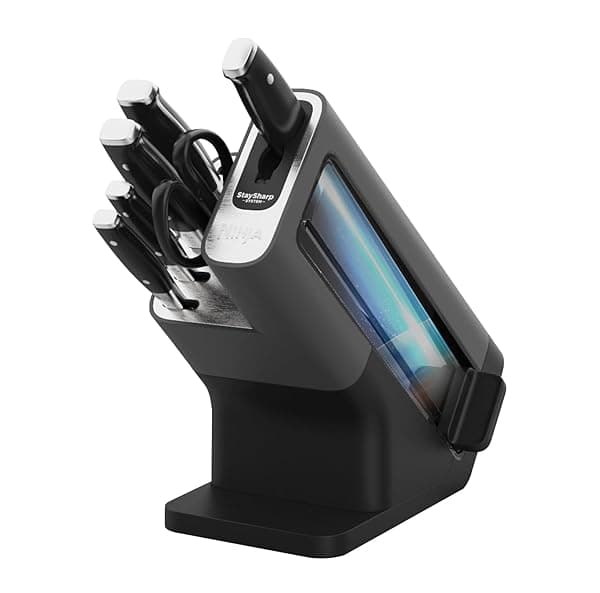
An integrated sharpener built into the block slot, as found on the Ninja Foodi StaySharp, removes the need to own a separate tool and makes it easy to hone before each use. Pull-through sharpeners are convenient but remove more metal per pass than a whetstone, shortening blade life over years. For stainless steel at 56–58 HRC, a pull-through or honing rod is perfectly adequate. For harder Japanese-style blades at 60+ HRC, a whetstone (1,000 grit for reshaping, 3,000–6,000 grit for finishing) gives the best results without risking micro-chips. In a hard-water area, rinse your whetstone with filtered water if possible, as mineral deposits can clog the abrasive surface. Whichever system you use, honing or sharpening every four to six uses keeps a blade performing far better than sharpening once a year.
Our top picks
Best for cooks who want built-in sharpening every timeNinja Foodi StaySharp Knife Block
The Ninja Foodi StaySharp K32006UK is a 6-piece set with a sharpening mechanism integrated directly into the block slot, so every draw and return hones the blade automatically. The set includes a chef's knife, bread knife, utility knife, paring knife and a pair of kitchen scissors. If you want sharp knives without remembering to use a separate tool, this is the most practical block-based solution in this group.
Best budget 14-piece set for a first shared kitchenKnife Set with Block
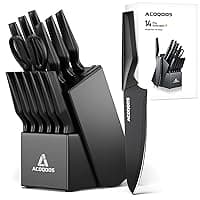
The ACOQOOS 14-piece set includes a built-in block sharpener and covers chopping, slicing and dicing with a full complement of knives including steak knives. At 14 pieces it gives a new household everything needed to start cooking without buying additional tools. The built-in sharpener means upkeep requires no extra equipment, which suits a first flat or student kitchen.
Best mid-range 14-piece set with German stainless steelD.Perlla Knife Set
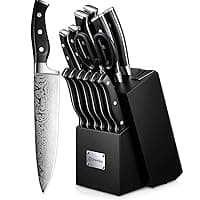
The D.Perlla 14-piece set uses German stainless steel blades with a self-sharpening wooden block, and includes steak knives alongside the core kitchen set. German stainless at this specification typically sits at 56–58 HRC, making it chip-resistant and straightforward to maintain with the integrated sharpener. The wooden block adds a traditional look that suits most UK kitchen worktops.
Best value 16-piece set with scissors and sharpener includedKnife Set
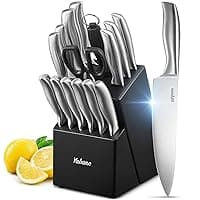
The Yabano 16-piece set uses German high-carbon stainless steel and includes meat scissors and a knife sharpener alongside the full knife complement. At 16 pieces it is the largest set in this group, making it suitable for a household that wants a single purchase to cover every cutting task. The wooden block accommodates all pieces in one footprint.
Best Japanese-style 15-piece set for keen home cooks15-Piece Japanese Chef Knife Set with
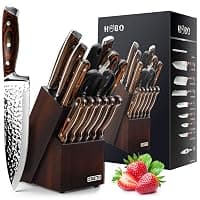
The HOBO 15-piece set uses Japanese high-carbon stainless steel, which typically achieves a harder, thinner edge than standard German stainless. The coloured wooden handles allow quick identification of each knife type, reducing cross-contamination risk when prepping raw meat and vegetables on separate boards. A block sharpener is included, and the 15-piece count gives a thorough range of blade shapes.
Best entry-level 5-piece set for a minimal kitchenHOBO Knife Set
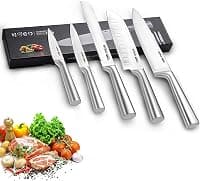
The HOBO 5-piece set includes both serrated and plain-edge blades with a non-slip frosted handle designed for wet-hand grip. Five pieces cover mincing, chopping and slicing without the bulk of a large block. The frosted polymer handle is easy to clean and maintains grip on a damp worktop, which is a practical advantage in everyday UK kitchen conditions.
Best knife storage for cooks who travel or campTosnail Chef Knife Roll Bag
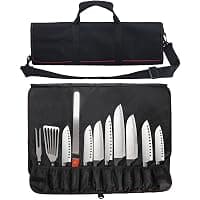
The Tosnail knife roll has 21 individual slots plus a large zip pocket, accommodating a full professional kit in a single carry case. A shoulder strap and easy-carry handle make transport straightforward whether you are heading to a campsite or a friend's kitchen. The heavy-duty canvas construction protects blades during transit without the bulk of a wooden block.
Frequently asked
Is carbon steel or stainless steel better for kitchen knives?
The answer depends on how much maintenance you are willing to do. Carbon steel can be ground to a finer, more acute edge and holds that edge well between sharpenings, making it a favourite among enthusiasts who cook daily and enjoy the sharpening process. Stainless steel resists corrosion thanks to its chromium content, tolerates a damp UK kitchen environment and requires far less aftercare. For most home cooks, stainless steel at 56–58 HRC is the practical choice. Carbon steel rewards those who will dry and oil the blade after every single use.
What does HRC mean on a kitchen knife?
HRC stands for Hardness Rockwell C, the scale used to measure how resistant a material is to permanent deformation. On kitchen knives, a higher HRC number means the blade can hold a sharper edge for longer but becomes more brittle and prone to chipping under lateral stress. German-style stainless knives typically fall at 56–58 HRC: tough, chip-resistant and easy to sharpen at home. Japanese-style knives often reach 60–67 HRC, allowing a thinner bevel but requiring more careful use and a whetstone rather than a standard honing rod to maintain without damage.
How many knives do I actually need in a kitchen knife set?
Three knives handle the vast majority of home cooking tasks: a 20cm chef's knife for general chopping and slicing, a 13cm utility knife for smaller prep work such as trimming vegetables, and a serrated bread knife. Everything else in a large block set is useful occasionally but not essential. Steak knives are worth having if you regularly serve grilled or roasted meat at the table. Scissors are genuinely handy for portioning poultry or snipping herbs. A 14- or 16-piece set makes sense if you want a single purchase that covers every scenario, but a 5- or 6-piece set is sufficient for most households.
Can I put kitchen knives in the dishwasher?
Most manufacturers advise against it, and for good reason. The high-temperature wash cycle and harsh detergents dull the edge faster than hand-washing, and the heat causes wooden handles to crack and warp over time. Carbon steel blades will rust in a dishwasher environment. Even stainless steel knives benefit from hand-washing and immediate drying. If a knife's product description specifies dishwasher-safe, it usually refers to the handle material rather than the blade edge, which will still degrade faster with repeated machine washing.
What is the best way to sharpen kitchen knives at home?
For stainless steel knives at 56–58 HRC, a pull-through sharpener or a honing rod used before each session keeps the edge in good condition with minimal effort. For harder Japanese-style blades at 60+ HRC, a whetstone gives better results: use a 1,000-grit stone to restore a damaged edge and a 3,000–6,000-grit stone to refine and polish it. In a hard-water area, rinse the whetstone with filtered water to prevent mineral deposits clogging the abrasive surface. An integrated block sharpener, as found on the Ninja Foodi StaySharp, automates the process and suits cooks who want sharp knives without a separate routine.