
The choice between Japanese and German kitchen knives comes down to three measurable differences: steel hardness, blade angle, and weight. German knives use softer steel ground to around 20–25 degrees per side, making them robust for everyday UK cooking. Japanese knives use harder steel at 10–15 degrees, delivering a finer edge that rewards careful technique.
What to look for
01Steel hardness and edge retention
Steel hardness is measured on the Rockwell C scale (HRC). German knives typically sit at 56–58 HRC, which means the steel flexes rather than chips when it meets a hard butternut squash or a crusty sourdough crust. Japanese knives are commonly hardened to 60–67 HRC. Higher carbon content allows the steel to be hardened further, so the manufacturer can grind a finer, longer-lasting edge. The trade-off is brittleness: a Japanese blade dropped onto a tile floor or twisted sideways on a chopping board is more likely to chip. For a busy UK household where knives share a drawer or get the occasional rough treatment, a German-style blade at 56–58 HRC is more forgiving. If you prep delicate fish, paper-thin vegetables, or sushi-grade ingredients, the extra hardness of a Japanese blade pays dividends.
02Blade angle and cutting style
Blade angle determines how a knife moves through food. German knives are ground symmetrically at roughly 20–25 degrees per side, giving a robust V-edge suited to rocking cuts on a wooden board. Japanese knives are ground at 10–15 degrees per side, sometimes asymmetrically (single bevel), producing a scalpel-like edge ideal for push-cutting and pull-cutting techniques. In practical terms, a German chef's knife handles everything from halving a swede to mincing herbs with a rocking motion. A Japanese gyuto or santoku rewards a more deliberate, forward-slicing stroke. Neither is objectively superior; the right choice depends on how you already cook. Most UK home cooks who learned to chop with a rocking motion will find a German-angle blade immediately comfortable.
03Weight, balance and handle design
German knives are heavier, typically 200–280 g for a 20 cm chef's knife, with a full tang running through a bolstered handle. That weight does some of the work for you when breaking down a whole chicken or splitting a large pumpkin. Japanese knives are lighter, often 150–200 g, with a thinner spine and a handle that sits further back in the hand. Lighter knives reduce fatigue during long prep sessions, which matters if you cook from scratch daily. Handle material also affects grip in a wet UK kitchen: acacia wood handles look attractive but need hand-washing and occasional oiling; frosted or textured polymer handles tolerate more casual care. Check the handle length too: a 600 mm-wide drawer or knife block slot is standard in UK kitchens, so a set with a compact block footprint is worth prioritising.
04Maintenance and sharpening
Harder Japanese steel requires a finer-grit whetstone, typically 1,000–3,000 grit for maintenance and 6,000 grit for polishing, and more patience. A pull-through sharpener or a coarse honing steel can micro-chip a 62+ HRC blade. German steel at 56–58 HRC responds well to a smooth honing steel used weekly and a pull-through or electric sharpener every few months. Several sets in this guide include a built-in sharpener in the block, which is a practical solution for UK households that want sharp knives without a separate tool. If you live in a hard-water area (much of South East England and the Midlands), rinse and dry blades immediately after use: mineral deposits accelerate surface oxidation on high-carbon steel, regardless of whether it is German or Japanese in origin.
05Set size and what you actually need
A 14-piece or 16-piece set looks impressive, but most professional cooks rely on three knives: a chef's knife (18–20 cm), a paring knife (8–10 cm), and a serrated bread knife (20–23 cm). Steak knives, kitchen scissors, and a honing steel are useful additions; a second utility knife often duplicates the chef's knife. Larger sets make sense if you are equipping a kitchen from scratch or want matching steak knives for the table. Smaller 5-piece or 6-piece sets are better value if you already own a bread knife or scissors. Storage matters too: a wooden block keeps edges protected and accessible, while a knife roll with 21 slots suits cooks who travel or want to store knives safely without a permanent counter footprint.
Our top picks
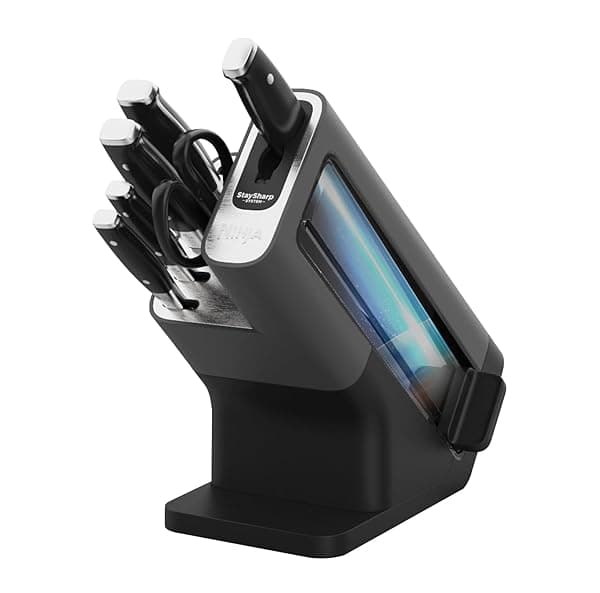
Best for home cooks who want self-maintaining edgesNinja Foodi StaySharp Knife Block
The Ninja Foodi StaySharp K32006UK integrates a sharpening mechanism directly into the block, so each knife is honed every time you draw and return it. The 6-piece set covers the core tasks: chef's knife, bread knife, utility knife, paring knife, and kitchen scissors. The block has a compact footprint that fits neatly on a 600 mm worktop section. German-style stainless steel construction keeps maintenance demands low for everyday UK cooking.
Best budget set for a first kitchenKnife Set with Block
The ACOQOOS 14-piece set includes a built-in block sharpener alongside chopping, slicing, and dicing knives, plus steak knives, at a price point that makes it the most accessible option in this guide. The wooden block stores all 14 pieces upright, protecting edges and keeping a small counter area tidy. For a student flat or a first home where budget is the primary constraint, this set covers every everyday cutting task without requiring a separate sharpening tool.
Best mid-range set with German steel and steak knivesD.Perlla Knife Set
D.Perlla's 14-piece set uses German stainless steel throughout and includes steak knives alongside the core kitchen blades, all stored in a self-sharpening wooden block. The black finish on handles gives a uniform, professional look. At 14 pieces it covers a full household's needs, from fine vegetable prep to table service, without the price premium of a premium Japanese-steel set. The self-sharpening block mechanism suits UK households that want consistently sharp knives with minimal effort.
Best large set for equipping a kitchen from scratchKnife Set
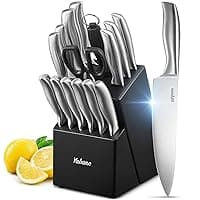
Yabano's 16-piece set includes German high-carbon stainless steel chef's knife, steak knives, meat scissors, and a knife sharpener, making it the most complete single purchase in this guide. The wooden block stores all 16 pieces safely. Meat scissors are a genuinely useful addition for portioning poultry or trimming fat, tasks where a knife on a board is less efficient. This set suits anyone setting up a new kitchen who wants a single purchase to cover every cutting task.
Best for cooks who want Japanese-style high-carbon steel15-Piece Japanese Chef Knife Set with
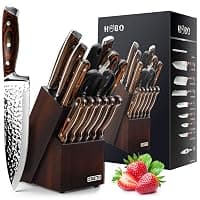
The HOBO 15-piece set uses high-carbon stainless steel with Japanese-style construction and colour-coded wooden handles that make it easy to identify each blade at a glance. At 15 pieces it includes a sharpener and a wooden block. The high-carbon steel holds a finer edge than standard stainless, rewarding cooks who are willing to maintain blades with a whetstone. The colour handle design also helps households where multiple people cook and need to distinguish knives quickly.
Best entry-level 5-piece set for minimal counter spaceHOBO Knife Set
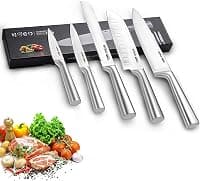
HOBO's 5-piece stainless steel set includes both serrated and standard blades with a non-slip frosted handle that maintains grip in a wet kitchen environment. At five pieces it covers bread, mincing, chopping, and slicing without a block, making it ideal for a small flat where counter and storage space is limited. The frosted polymer handle requires no special maintenance, unlike wood, and tolerates the occasional dishwasher cycle better than natural materials.
Best for cooks who travel or need portable knife storageTosnail Chef Knife Roll Bag
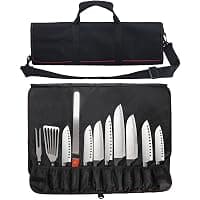
The Tosnail knife roll provides 21 individual blade slots plus a large zip pocket, with both a carry handle and a shoulder strap. It is made from heavy-duty canvas, protecting edges during transit without the rigid bulk of a block. For a cook who moves between kitchens, attends supper clubs, or simply wants to store knives safely in a drawer rather than on the counter, this roll is a practical alternative to a static block. The 21-slot capacity accommodates a full professional set.
Frequently asked
What is the difference between Japanese and German kitchen knives?
The core differences are steel hardness, blade angle, and weight. German knives use steel hardened to around 56–58 HRC, ground at 20–25 degrees per side, and are heavier, typically 200–280 g for a 20 cm blade. Japanese knives use steel hardened to 60–67 HRC, ground at 10–15 degrees per side, and are lighter. German knives are more durable under rough use; Japanese knives hold a finer edge but chip more easily if dropped or twisted.
Which kitchen knives are best for everyday UK home cooking?
For most UK home cooks, a German-style chef's knife (18–20 cm), a paring knife (8–10 cm), and a serrated bread knife (20–23 cm) cover 95 per cent of tasks. German steel at 56–58 HRC tolerates a pull-through sharpener and a weekly honing steel, which suits households that want sharp knives without a dedicated sharpening routine. A 6-piece or 14-piece set with a built-in block sharpener is the most practical starting point.
How do I sharpen high-carbon steel kitchen knives?
For German steel at 56–58 HRC: use a smooth honing steel weekly to realign the edge, and a pull-through or electric sharpener every two to three months to restore the bevel. For Japanese steel at 60+ HRC: use a whetstone at 1,000 grit to remove metal, then 3,000 grit to refine, and 6,000 grit to polish. Avoid coarse pull-through sharpeners on hard Japanese steel as they can micro-chip the edge. Always dry blades immediately after washing, particularly in hard-water areas.
Are wooden knife block handles safe to put in the dishwasher?
No. Wooden handles and wooden blocks should be hand-washed only. The high heat and prolonged moisture in a UK dishwasher causes wood to swell, crack, and split over time, which loosens the handle rivets and degrades the block slots. Acacia and other hardwood handles also benefit from occasional treatment with food-safe mineral oil to prevent drying out in centrally heated homes. Polymer and frosted handles are more tolerant of moisture but still last longer with hand-washing.
How many knives do I actually need in a kitchen knife set?
Three knives cover the vast majority of home cooking tasks: a chef's knife for chopping and slicing, a paring knife for peeling and detail work, and a serrated bread knife for loaves and tomatoes. A utility knife (13–15 cm) is useful for tasks between the chef's and paring knife in scale. Steak knives, scissors, and a honing steel are practical additions but not essential. A 14-piece or 16-piece set makes sense when equipping a kitchen from scratch or when matching steak knives for the table are a priority.