
Choosing between bean-to-cup and pod coffee machines comes down to three things: how much control you want, how much counter space you have, and how often you brew. The UK market now spans from a £38 manual press to fully automatic machines with touch displays, so there is a clear option for every kitchen and every morning routine.
What to look for
01Running costs: beans versus pods
Pod machines look affordable upfront, but the capsules add up fast. A standard Nespresso-compatible pod delivers one espresso-sized shot, and if you drink two cups a day across a household, you are consuming roughly 700 pods a year. Whole-bean machines grind fresh for each cup, and a kilogram of quality beans typically yields around 120 to 140 espresso shots, making the per-cup cost considerably lower over time. If you are buying for a household of two or more adults, the cumulative bean saving across a year is substantial. Pod machines do have one genuine advantage: zero waste from over-extraction or stale grounds, because each capsule is a sealed, pre-dosed unit. For occasional drinkers who brew fewer than five cups a week, that convenience and consistency can outweigh the higher per-cup cost. For daily drinkers, the maths strongly favours beans.
02Grinder quality and grind settings
Bean-to-cup machines with integrated grinders vary enormously in burr quality. Conical steel burrs, as found in the Sage Barista Express and Barista Express Impress, produce a consistent particle size that extracts evenly at 9 bar pressure. Cheaper blade-style grinders chop unevenly, which leads to bitter over-extraction and sour under-extraction in the same shot. The Sage Barista Express offers 25 grind settings, giving you fine control over extraction time. The Breville Barista Max uses a 15-bar Italian pump, which is the standard pressure for espresso, and pairs it with an integrated grinder and a 2.8-litre water tank, meaning fewer refills on a busy morning. If you live in a hard-water area (much of southern England and the Midlands), look for a machine with a built-in water filter or a descaling alert, because limescale damages burrs and heating elements faster than anything else.
03Footprint and kitchen fit
UK kitchen worktops are typically 600 mm deep, and many fitted kitchens have wall cupboards starting at around 450 mm above the surface, which limits machine height. Fully automatic bean-to-cup machines like the De'Longhi Rivelia are described as compact for the category, but you still need to account for the bean hopper on top and clearance for the drip tray below. The AeroPress Go collapses into its own mug, making it genuinely travel-sized and the only option here that fits in a bag. Pod machines tend to be slimmer than bean-to-cup models because they carry no grinder mechanism. If your kitchen has limited worktop width, measure carefully before ordering: most full-size espresso machines are 30 cm to 35 cm wide, while compact pod machines can be as narrow as 16 cm.
04Milk frothing: manual wand vs automatic system
If you drink flat whites, lattes, or cappuccinos regularly, the milk system matters as much as the espresso unit. Manual steam wands, as on the Sage Barista Express and Breville Barista Max, run off the machine's boiler and require you to texture the milk yourself, which takes practice but gives you full control over microfoam density. Automatic frothers, such as the De'Longhi LatteCrema Hot system on the Rivelia and the automatic frother on the Magnifica Evo Next, draw milk directly from a carafe and deliver it at a set temperature and texture. For households where multiple people make coffee at different skill levels, an automatic system removes the learning curve entirely. The Sage Barista Express Impress adds an assisted tamping mechanism, which standardises the 30 lb (approximately 13.6 kg) of tamp pressure needed for consistent extraction, reducing one of the most common beginner errors.
05Manual brewing: when no machine beats a press
The AeroPress Go is not an espresso machine in the technical sense: it uses air pressure applied by hand rather than a pump, and it operates at lower pressure than the 9-bar standard. What it produces is a concentrated, smooth brew that many people find less bitter than pump espresso, and it can make one to three cups in under a minute. It runs on no electricity at all, which makes it the only option here that works in a caravan, a hotel room, or a UK campsite. For anyone who already owns a kettle and wants cafe-quality coffee without a mains-powered machine on the worktop, it is a genuinely practical choice. It is also the only product in this guide that fits in a coat pocket.
Our top picks
Best for travel and off-grid brewingAeropress Go Portable Travel Coffee Press
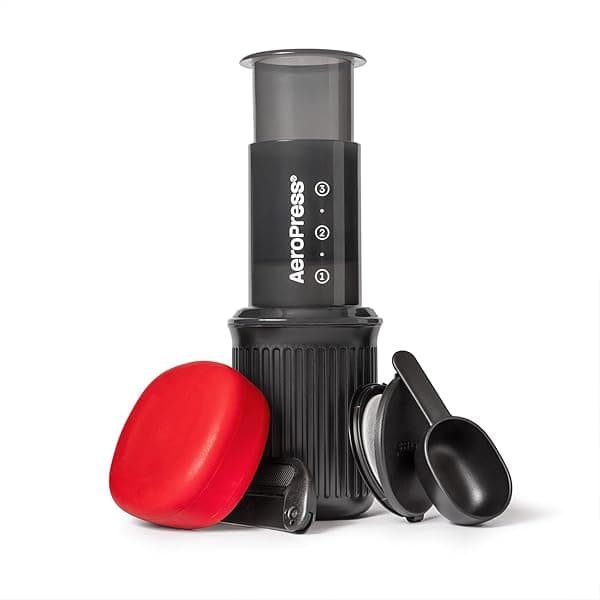
The AeroPress Go uses manual air pressure rather than a pump, requires no mains electricity, and packs into its own 296 ml mug. It brews one to three cups in under a minute using any grind size, from coarse for cold brew to fine for espresso-style concentrate. The entire kit weighs under 300 g, making it the only option here that genuinely fits in a travel bag. A solid choice for commuters, campers, or anyone with a tiny kitchen and no worktop to spare.
Best bean-to-cup for espresso enthusiastsSage Barista Express
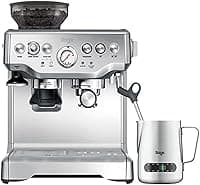
The Sage Barista Express integrates a conical burr grinder with 25 grind settings directly into the machine body, so beans go from hopper to portafilter in seconds. It pulls shots at 9 bar through a thermocoil heating system and includes a manual steam wand for milk texturing. The brushed stainless steel housing is built to last on a UK 240V supply. It suits anyone who wants hands-on control over every variable without buying a separate grinder.
Best for consistent espresso with less techniqueSage Barista Express Impress
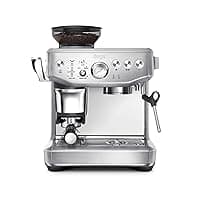
The Sage Barista Express Impress adds an assisted tamping system to the Barista Express platform, applying standardised pressure automatically so every puck is tamped to the same depth. It retains the 25-setting conical burr grinder and 9-bar extraction, and the brushed stainless steel build is identical in quality to its sibling. If inconsistent tamping has been ruining your shots, this machine removes that variable entirely, making it the better choice for households where more than one person makes espresso.
Best fully automatic for milk-based drinksDe'Longhi Magnifica Evo Next ECAM312.80.TB
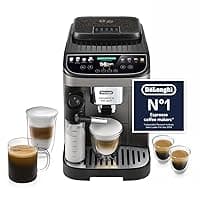
The De'Longhi Magnifica Evo Next ECAM312.80.TB uses an automatic milk frother to prepare cappuccinos and lattes at the touch of its intuitive display, with no manual steaming required. It is a bean-to-cup machine with an integrated grinder, so every cup starts from whole beans. The black and titanium finish suits modern UK kitchens, and the automatic frother system means anyone in the household can produce a consistent milk drink regardless of barista experience.
Best compact fully automatic with colour displayDelonghi Rivelia EXAM440.55.G
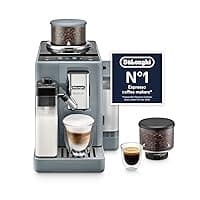
The De'Longhi Rivelia EXAM440.55.G offers 16 drink recipes through a full-colour touch display in a body described as compact for the fully automatic category. The LatteCrema Hot automatic milk system draws from a carafe and delivers textured milk without manual intervention. At 16 recipes, it covers everything from ristretto to cold brew-style drinks. The pebble grey finish is a practical choice for UK kitchens where stainless steel shows fingerprints, and the compact footprint helps on a 600 mm-deep worktop.
Best entry-level bean-to-cup automaticGaggia Naviglio Automatic Bean to Cup
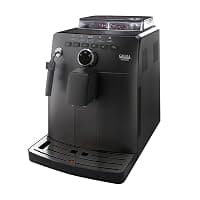
The Gaggia Naviglio is a fully automatic bean-to-cup machine that grinds, tamps, and brews in one cycle, producing espresso and cappuccino without manual steps. Its black housing is straightforward and uncluttered, and the automatic operation makes it accessible for first-time bean-to-cup buyers. For a household stepping up from a pod machine for the first time, it offers the core bean-to-cup experience at a lower entry point than the Sage or De'Longhi flagships.
Best mid-range espresso machine with large tankBreville Barista Max Espresso Machine |
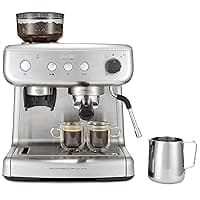
The Breville Barista Max pairs a 15-bar Italian pump with an integrated bean grinder and a 2.8-litre water tank, one of the largest in this category, which means fewer refills during a busy morning in a household of three or four. The steam wand is manual, giving you control over milk texture for lattes and cappuccinos. The stainless steel build handles daily use on UK 240V mains, and the 15-bar pump meets the standard pressure specification for espresso extraction.
Frequently asked
Is a bean-to-cup machine worth it compared to a pod machine?
For daily drinkers, yes. Bean-to-cup machines grind fresh for every cup, which produces better flavour and a lower cost per shot than pre-dosed capsules. The trade-off is a larger footprint, a learning curve for dialling in grind settings, and a higher upfront cost. Pod machines are simpler, faster to clean, and better suited to occasional drinkers or households where convenience matters more than per-cup economy. If you drink two or more cups a day, the bean-to-cup running cost advantage compounds significantly over a year.
What pressure do I need for proper espresso?
The industry standard for espresso extraction is 9 bar of pressure. Most machines in this guide, including the Sage Barista Express and the Breville Barista Max with its 15-bar Italian pump (which regulates down to 9 bar at the group head), meet this specification. Machines marketed with very high bar figures, such as 19 or 20 bar, are often referring to pump capacity rather than extraction pressure. What matters is the pressure delivered at the portafilter, not the pump's maximum output.
How often do I need to descale a coffee machine in the UK?
In hard-water areas, which cover most of southern England, the East Midlands, and parts of Yorkshire, descaling every four to eight weeks is realistic for a daily-use machine. In soft-water areas such as Scotland and the South West, every three to four months is more typical. Most modern machines, including the De'Longhi Magnifica Evo Next and the Rivelia, include an automatic descaling alert. Using filtered water or a built-in water filter extends the interval and protects the heating element and burrs from limescale damage.
Can I use any coffee pods in a Nespresso-compatible machine?
Yes. Nespresso-compatible machines accept any capsule that follows the original Nespresso geometry, including third-party options such as CafePod. The CafePod Lungo and Espresso capsules in this guide are designed to fit original-format Nespresso machines. Note that Nespresso Vertuo machines use a different, proprietary capsule format with a barcode rim, and third-party compatibility is much more limited for that system. Always check whether your machine uses the original or Vertuo format before buying capsules.
How much worktop space does a bean-to-cup machine need?
Most full-size bean-to-cup machines are 30 cm to 35 cm wide and 35 cm to 45 cm deep, and the bean hopper adds 10 cm to 15 cm of height above the machine body. UK fitted kitchens typically have wall cupboards starting 450 mm above the worktop surface, so measure your clearance before ordering. Compact models such as the De'Longhi Rivelia are designed to reduce the footprint, but you still need to account for the milk carafe alongside the machine. The AeroPress Go is the only option here that requires no dedicated worktop space at all.